New Report on how the Philanthropy of the Rich costs the public, confirms what we have seen here in West Michigan
The U.S. charitable system is shaped by laws — particularly those set out by a sweeping charitable tax reform package passed in 1969. Over the five decades since then, however, we’ve witnessed an extraordinary concentration of wealth and power in the hands of our wealthiest citizens. We’ve also witnessed the attendant explosion of a wealth-defense industry — tax attorneys, accountants, and wealth managers — who have an institutional bias toward unlimited capital accumulation, tax minimization, and dynastic succession. That bias has crept its way into the philanthropic sphere as well. The meteoric rise of donor-advised funds as giving vehicles, for example, has been driven in part by wealth advisors selling tax-avoidance products. You will get a play-by-play of financial industry shell games in our discussion of how wealthy donors are gaming foundation excise taxes and payout requirements. And there are signs that some billionaires are starting to think that certain for-profit investments are a replacement for philanthropy — or even that their own companies are more socially beneficial than any sort of giving.

This paragraph above is from a new report by the Institute for Policy Studies, entitled, The True Cost of Billionaire Philanthropy. The reason why In think this report is so important is that it confirms many of the things I have been writing about in regards to the wealthiest families in West Michigan, their philanthropy through foundations and their charitable contributions. I’m speaking specifically about the DeVos and Meijer families, the two billionaire families in West Michigan, but this new report also could apply to some of the other sizable foundations in the Greater Grand Rapids area, such as the Jandernoa Foundation, the Secchia Foundation, the Cook Foundation, the Wege Foundation, the Van Andel Foundations and the Frey Foundation.
Here are some of the major findings in the report, The True Cost of Billionaire Philanthropy, which is what we have seen with the wealthy philanthropists in West Michigan.
What Ultra-Wealthy Philanthropists Costs Us?
- We know for certain that $73.34 billion in tax revenue was lost to the public in 2022 due to personal and corporate charitable deductions.
- If we include just the little data we have about charitable bequests and the investments of charities themselves, the revenue loss is pushed up to roughly $111 billion.
- And if we also include the capital gains revenue lost from the donation of appreciated assets, the true revenue costs of charity likely add up to several hundreds of billions of dollars each year.
The news is full of stories about billionaires giving huge gifts to charity. But for all but the most generous, their giving is nowhere close to keeping up with the growth in their wealth. And while some billionaires make an earnest effort to give back, others appear to be using philanthropy more to enhance their public image, their political voice, and even their wallets.
The wealth of billionaire philanthropists has grown exponentially. For example, “The 73 living U.S. Giving Pledgers who were billionaires in 2010 saw their wealth grow by 138 percent, or 224 percent when adjusted for inflation, through 2022. Their combined assets increased from $348 billion to $828 billion over those twelve years.”
A 2021 report from the Council on Michigan Foundations, or CMF, showed that the money flowing out to working charities from donor-advised funds at community foundations in Michigan was astonishingly slow. Based on account-level data for 2,600 DAFs, CMF found that in 2018 the median payout rate for Michigan’s DAF accounts was just 3.1 percent.
And it gets worse. The CMF found that in 2020, only 43 percent of DAF accounts paid out grants to charity at 5 percent or more—the minimum currently required of private foundations. 22 percent of the accounts paid out less than 5 percent. And 35 percent—more than one third— paid out nothing at all to charity that year.
In fact, on average, 37 percent of Michigan’s DAF accounts don’t pay out any money in any given year. And most of Michigan’s community foundations require a DAF to make a distribution at least once every three years — making it likely that if this requirement didn’t exist, the portion of DAFs that didn’t distribute anything to charity in any given year would be even higher.
What Billionaire Philanthropists Cost Us? 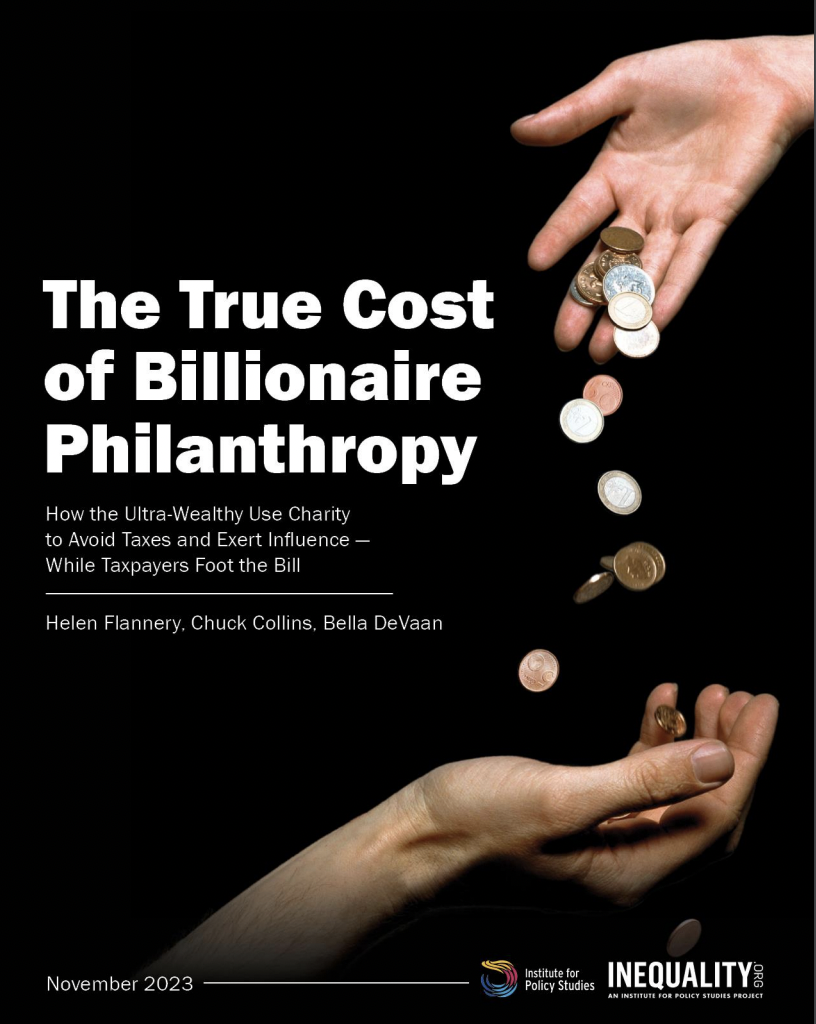
Our national tax system contains a large and complex set of deductions, exclusions, and other provisions related to charitable giving. All of this results in lost tax revenue, forcing less wealthy taxpayers to pick up the slack to fund crucial public services. There is broad public support for this taxpayer subsidy for charitable giving when funds reach working charities in a timely manner.
In fact, according to nonprofit law experts Ray Madoff and Roger Colinvaux, if you add up all the possible federal charitable tax reductions related to income, capital gains, estate, and gift taxes, taxpayers can subsidize wealthy philanthropists by up to 74 cents for every dollar those philanthropists donate. And the wealthier the donor, the larger the public subsidy.
The last time Congress overhauled the legal framework for the philanthropic sector was in 1969, when wealth was considerably less concentrated than it is now. This framework provided important tax-reduction incentives to encourage timely giving to charity — but it also created the loophole that allowed for the commercial exploitation of donor-advised funds. It is time to modernize the rules governing philanthropy to:
- Promote a robust independent nonprofit sector outside of individual, political, and corporate influence.
- Prevent abuses of the tax system by philanthropy primarily used for aggressive tax avoidance or as a means to maintain control over donated dollars.
- Protect democracy and public society from the undue influence of private wealth and power.
Again, I am sharing the major findings from this new report, because I believe that it is reflective of some of the same dynamics I have seen with local wealthy foundations and how it negatively impacts the community.To read the GRIID section where we monitor local wealthy foundation, go to this link. Ultimately, we need to pay attention to these dynamics, because the rich not only costs the public, it impacts how we normalize and even valorize members of the Capitalist Class to our own detriment.
 Grand Rapids Institute for Information Democracy
Trackbacks
Comments are closed.