There has been an increase in FOIA requests, primarily because of the increased repression by the GRPD against dissident groups in Grand Rapids
On Tuesday, the Grand Rapids City Commission approved an additional $194,942 for the GRPD, in order to hire two more people for their Police Records Unit.

According to the Agenda Packet (page 209) for Tuesday’s City Commission meeting, the GRPD provides the following reason(s) for the increased staff:
Since 2018, the Police Records Unit experienced a 100 percent increase in Freedom of Information Act (FOIA) requests. This number continues to rise in connection to GRPD’s use of new technology, such as body cameras and small unmanned aerial systems. Without appropriate staffing adjustments, new gun reform laws taking effect early in 2024—including establishing universal background checks for gun purchases and the extreme risk protection orders package (or “red flag laws”)—will further strain response times and operations of the Records Unit. The Grand Rapids Police Department (GRPD) Records Unit (Records Unit) requests the addition of two (2) Police Records Specialist (civilian) positions to its permanent personnel roster. The annual estimated cost for these two positions using FY2024 rates at the C-Step is $194,942. These additional staff resources to better manage the workload, combined with process improvements and efficiencies, will improve the responsiveness, transparency, and accountability of GRPD. Failure to adequately staff the Records Unit in response to the current FOIA and records request backlog and in preparation for the additional workload demands anticipated under the new firearms law will result in additional—and avoidable—delays to the detriment of both efficient service to the public and other entities and to the responsiveness, transparency, and accountability of the department. This budget amendment request would appropriate sufficient funding for these positions over the remainder of FY2024. These positions will be projected for the full year in FY2025 and beyond as part of the annual budget development process.
One important question we should all ask ourselves about this nearly $200,000 request from the GRPD to add two additional staff is, why has there been a 100% increase in FOIA requests since 2018?
The GRPD request doesn’t provide an answer, and the City Commissioners didn’t raise the question before approving the extra $200,000. As someone who has requested FOIA documents from the GRPD and some who has been the target of GRPD surveillance, harassment and arrest, thus the subject within FOIA documents, I would like to offer up some observations about why FOIA requests to the GRPD have increased since 2018.
After the election of Donald Trump in 2016, the increased repression of the Trump Administration and how white supremacists and white nationalist had become more emboldened, there was a growing desire on the part of activists and organizers to escalate tactics within social movements to both expose the repression of the state and because of the urgency to resist what was happening throughout the country and in Grand Rapids. In 2017, groups like Movimiento Cosecha and GR Rapid Response to ICE were formed in response to the increased activity of Immigration and Customs Enforcement, along with the anti-immigrant rhetoric coming from the White House. Both of these groups and the larger Immigrant Justice Movement were using more Direct Action to challenge state repression.
 In May of 2020, after the more high profile cases of police murdering Black people, plus the George Floyd protest, people began to question and critique the very existence of the GRPD and policing in general. Groups like Justice for Black Lives and Defund the GRPD began organizing and using Direct Action to address the urgent issues around state repression.
Since then there have been other groups that have formed and morphed, especially after the GRPD murdered Patrick Lyoya in April of 2022. Therefore, the increase in FOIA requests is a direct response to the increase in police surveillance, harassment and repression against movement groups that have been using Direct Action as a primary tactic to demand justice.
For example, in 2019, GR Rapid Response to ICE submitted a FOIA request surrounding the GRPD’s role in monitoring and attempted repression of the immigrant justice movement, particularly around the time of the annual May Day march that Movimiento Cosecha had been organizing. A FOIA request was submitted in September of 2019, but documents were not released until January of 2020. However, the majority of the 271 pages received were redacted (linked here), leaving out vital information on what the GRPD knew, who they were targeting and what their plans were to suppress dissent. What follows is a brief analysis of what the 271 FOIA documents revealed.
It is the City’s position that the public interest in the disclosure of this information is outweighed by the public interest in keeping this information private. The core purpose of the FOIA is to contribute significantly to public understanding of the operations or activities of the government. Requests for information that involve private citizens in government files that reveal little to nothing about the inner working of government do not serve the core purpose of the FOIA.
Apparently, the GRPD does not want the public to know what they did, and more importantly, how they operate. So much for transparency.
On page 255, the FOIA document states this:

One could certainly make the point that the work of Movimiento Cosecha GR is anti-fascist, but the idea that there are “professional protesters” is just plain ridiculous.
Even more disturbing in the document on page 238, which shows what the GRPD was threatening to do if people marched in the street:
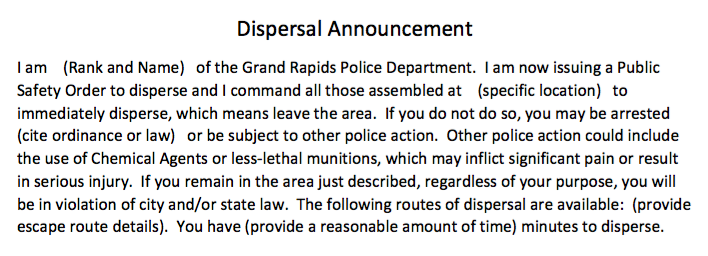
In late May of 2023, GRIID and the Comrade Collective submitted a FOIA request for GRPD surveillance, harassment and arrests of activists and organizing that had begun after Patrick Lyoya was murdered by the GRPD. We requested documentation that covered from the first protest after Lyoya’s murdered in April of 2022, through the first anniversary of his death on April 4, 2023.
The GRPD responded by saying:
A preliminary search resulted in thirteen (13) incident reports and five (5) SRT operation plans. One (1) incident report has been previously released under FOIA. This one (1) incident report is included in this response and produced free of charge.
In addition, they wrote:
Please be advised that due to the amount of FOIA requests we’re currently processing, it is estimated that once deposit payment is received, it will take eight to ten (8-10) months until you receive the final invoice and/or records.
Therefore, it is likely that we will not received the FOIA-requested documentation until January of 2024 at the earliest or no later than March of 2024. Once we have those documents in hand and have had a chance to assess their meaning, we will likely hold a press conference to reveal what the documents tell us about how the GRPD was responding to the movement to demand justice for Patrick Lyoya.
It seems clear to this writer that the only real reason that the GRPD wants to add two more staff people to deal with the increased requests for FOIA documents, is specifically because there is not only greater scrutiny of the Grand Rapids Police Department, but a greater awareness of the ways that the GRPD suppresses dissent in this community.
 Grand Rapids Institute for Information Democracy
Trackbacks
Comments are closed.