What I presented at the Great Lakes History Conference on A People’s History of Grand Rapids
Since the theme of this year’s conference is Division and Reaction: Democracy in Peril, my paper will present on a People’s History of Grand Rapids.
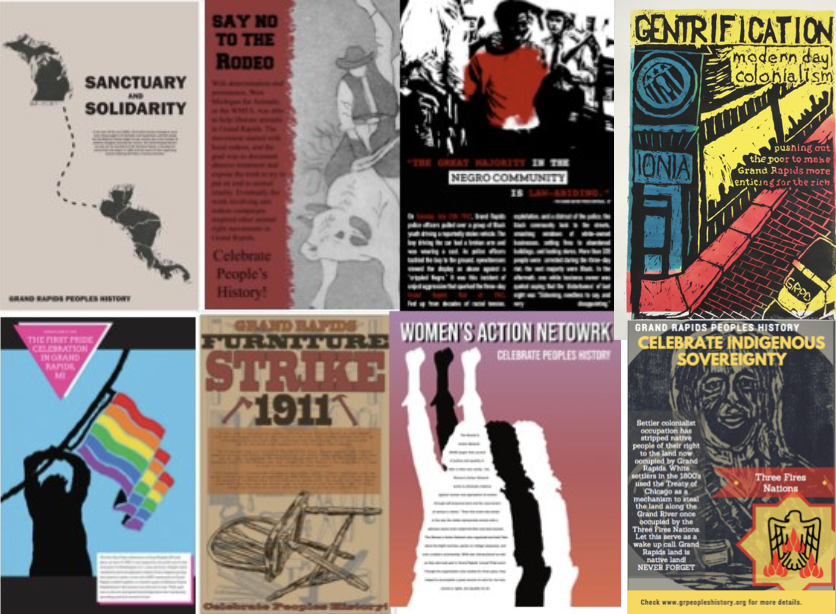
I would contend that the issue of rule by the people, democracy, has always been in peril in the area that is now called Grand Rapids, and I will support this argument with several examples. But first, I want to share a story about 2 separate incidents that took place within 10 days of each other in late May of 2020 in Grand Rapids.
In the 3rd weekend of May, the American Patriot Council hosted a rally at Rosa Parks circle in downtown Grand Rapids. This is the same group that had one month earlier held a rally at the Lansing State Capitol, with lots of white guys with guns walking in and out of the Capitol building with no resistance from the Capitol security. At their rally in Grand Rapids, where about 200 people showed up, they were openly calling for the arrest of Gov. Whitmer, the Michigan Attorney General and the Secretary of State. Once again, there were numerous white men with guns present, along with the fact that no one was wearing a mask in the middle of a pandemic.The GRPD was keeping their distance throughout the rally, mostly sitting in squad cars around the perimeter of the park. Several of the organizers of the rally were later brought up on charges of for participating in the January 6th insurrection in Washington in 2021. In addition, several of the armed men who were on the stage at the rally in Grand Rapids, were later charged in the attempted plot to kidnap Gov. Whitmer.

One week later, also beginning at Rosa Park Circle, Black organizers had organized a rally and march to call attention to the numerous police killings of Black people across the US, with George Floyd being the most recent. None of the Black organizers or the thousands of people who attended the rally/march had guns. This Black Lives Matter rally/march did not asks for a permit and the police did not have an issue with that, based on their lack of response to the march, which took over the street on Fulton and Division. The march then came to the Grand Rapids Police Station, which had some barricades set up, with around 50 bike cops lined up with riot gear. This march/confrontation was initially non-violent until the GRPD began shooting tear gas and sped canisters at protesters. After that, protesters set fire to several cop cars, smashed widows of government buildings and some businesses in the downtown area. Numerous arrests were made, the Mayor called for a state of Emergency, brought in the Michigan National Guard and imposed a curfew for downtown Grand Rapids.

I shared these two stories from May of 2020 to primarily make a point that when white men with guns who are calling for the arrest and removal of State government officials, the state did virtually nothing to limit their speech or to attack them with tear gas or other crowd dispersing weapons. However, when BIPOC people, without guns, were protesting police murders of Black people, the response from the state was markedly different. There were cops in riot gear, cops preventing the public from entering the police station, plus there were regional police departments, the Kent County Sheriff’s Dept. and even Michigan State Police on hand to suppress those who were confronting state violence. The clear racial bias in how the state responds to public resistance is clear and can only make sense when we recognize that the contrast of these actions are rooted in White Supremacy.
Now, I wanted to share a few other historical examples from Grand Rapids, which challenges the notion that somehow the current political climate is more divided than at any time in the nation’s history. I want to use four examples: 1) looking at how Euro-Americans treated Indigenous people in what is now called Grand Rapid, 2) the Capitalist Class response to the 1911 Furniture Workers Strike and its aftermath, 3) the backdrop to the structural racism that the Black people in Grand Rapids were dealing with, which erupted in the riot of 1967, and 4) how the LGBTQ community fought against homophobia, transphobia and heterosexism in Grand Rapids in the 80s and 90s.
There are numerous other examples I could provide, but these four should be sufficient to make my point that from the very founding of Grand Rapids, there has always been division and reaction, and that the only way for marginalized communities to be able to be part of this city was to fight for a more expansive sense of democracy and to resist the reactions of the dominant society to submit to their worldview.
Indigenous Resistance
 In Z.Z. Lydens’ book, The Story of Grand Rapids, Lydens attempts to portray what happened to the native population as mild compared to other parts of the country. “The history of Grand Rapids does not have a backdrop of conflict with the Indians. There were no tales of raids and scalping and scourging of the settlement with flame.”
The reality is that thousands of Indigenous people lived along the Grand River prior to the European invasion. Most in these native communities experienced displacement by force, religious colonization, the flooding of their communities with alcohol, and displacement through legal maneuvers known as treaties. There were numerous treaties that resulted in the takeover of Native land by settler colonialists throughout what is now called Michigan, but settler colonialists have a long history of violating those treaties.
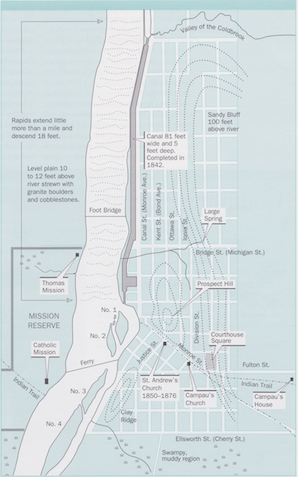 In terms of what this meant for Native people who lived along the Grand River, many of them fled to other areas in the Great Lakes in the first half of the 19th century, hoping for a better chance to survive.
While it is true that the level of violence against Native people in the Grand River area was not as overt as it was for other Indigenous nations, the violence was real and systemic. Lydens’ commentary above is instructive since it purposely works within a limited understanding of violence and ignores how settler colonialism functions.
Settler Colonialism was practiced in what is now Grand Rapids through traders like Louis Campau and Lucious Lyons, alongside Christian missions on both sides of the Grand River, the Baptists on the westside and the Catholic on the Eastside. These mission pitted Native people against each other and the Baptists got one indigenous leader, Chief Noonday, to sign the 1821 Treaty of Chicago, which ultimately paved the way for the displacement of Native people and the takeover of lands by Euro-American Settler Colonialists. The Catholic Church also played a major role in taking Native children from their communities and placing them in boarding schools in three keys places in Michigan, a tactic that falls under the broader category of genocide, as defined by the UN’s Genocide Convention of 1948. I would therefore argue that the major contributing factors in what Euro-Americans did to Native people in the West MI area were rooted in the ideologies of Manifest Destiny, Christian conversion and Capitalist expansion.
Worker resistance to the Furniture Barons
In the Spring of 1911, some 6,000 furniture workers went on strike to demand the right to unionize, the right to better working conditions and better wages. The Grand Rapids furniture barons responded by bringing in scab workers and using local police to suppress the strike.
 The 1911 strike was founded on longstanding worker grievances. As early as 1909, the workers discovered that the price of the furniture they produced had increased by 10%, and they demanded that their wages be increased. Some of the workers who called for the increase were fired shortly thereafter for being agitators.
Just prior to the beginning of the strike, the Grand Rapids Employers Association sent Francis Campau to deliver a message to the press, in order to influence public opinion, that workers were being treated fairly. Francis Campau was the grandson of the brother of Louie Campau, the so-called founder of Grand Rapids.
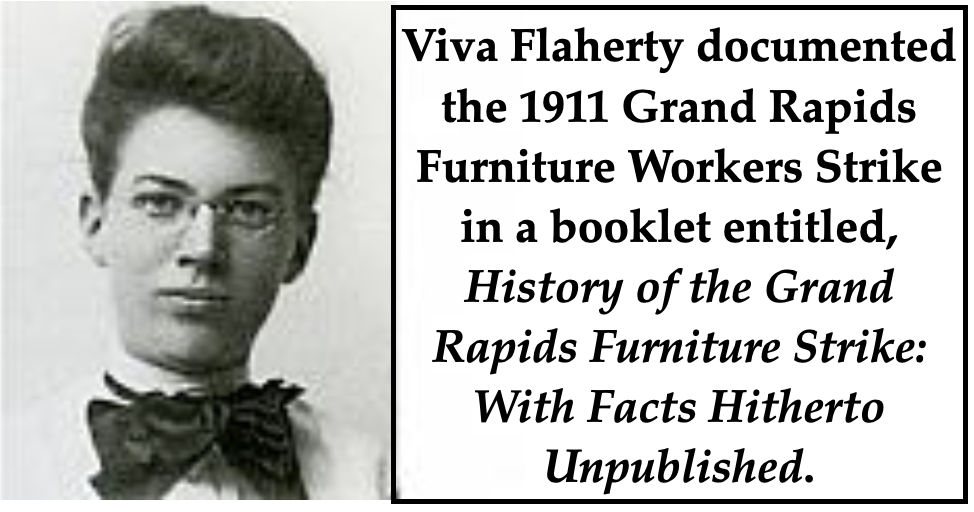
Furniture workers, on the other hand, had a very different view of life working in those factories. One important source that reflected the worker’s perspective was a booklet called, History of the Grand Rapids Furniture Strike: With Facts Hitherto Unpublished.14 This document was created by Viva Flaherty, a secretary at Fountain Street Church and a known Socialist. Flaherty documented the 1911 strike because she believed that the “people of Grand Rapids are awakened and enlightened and they can be trusted with the whole truth.”
Flaherty makes it clear in her version of the story that the strike was able to endure because of the seven unions that were involved, with membership of over 4,000 workers in thirty-five shops in Grand Rapids. She also documented that the Christian Reformed Church would not grant their members the right to be part of the union, since labor rights and organizing were not “founded on divine right.”
Flaherty documents the kind of wages earned by those in the furniture industry, stating that of the eight thousand furniture workers employed in Grand Rapids, most made less than $2 a day.
 The Strike lasted until the early part of August and had the support of several of the city commissioners, and most vocally the Mayor of Grand Rapids. In addition, the Catholic Bishop of Grand Rapids, Bishops Schrembs, was also a vocal supporter, stating: “I consider the present labor situation in our city as a most deplorable one from every point of view. I would welcome and hasten the day when compulsory arbitration will force men dealing with their fellow men to let fairness and justice come to their own through reasonable methods rather than through the cowering of men’s hearts through the cruel pangs of hunger of their wives and children.” Schrembs was later moved to the Diocese of Toledo as a form of punishment for speaking out in support of furniture workers.
Now, the striking furniture workers did not win most of the demands they fought for, but their fight did build a larger culture of resistance and solidarity. This was evident in the 1911 Labor Day parade, with 10,000 people marching in the parade and hundreds more watching from the roadside. At the time, Grand Rapids only had a population of 100,000, thus 10% of the community walked in the Labor Day parade.
However, The 1911 furniture workers strike was perceived by the furniture barons and other members of the local power structure as a serious threat. Those with a great deal to lose at the hands of striking workers took other steps to protect their interests. And they did not forget that Mayor Ellis had denied them permits for a private army. The City of Grand Rapids was made up of 12 political wards in 1911, with many of the wards dominated by certain ethnic groups – Polish, Dutch, German, Italian, etc. Most of the ethnic groups – and many of the wards – supported the furniture workers strike.
In order to hold power, in 1916 the furniture barons and their political cronies decided to change the Grand Rapids City Charter to do two things:
- Gerrymander and reduce the diversity of the political wards, down from a 12-ward system to a 3-ward system, with 2 representatives for each ward. This would give immigrant and ethnic groups, who were also predominantly working class, less say in local government.
- Eliminate a strong mayor and make future mayors into glorified city commissioners with only one vote. The balance of power shifted to the non-elected city manager position.
This has been the political system in Grand Rapids ever since, because the members of the Capitalist Class were so threatened by the working class, thus they changed the political system in their favor.
The Black Freedom Struggle and the 1967 riot in Grand Rapids
For decades the Black community in Grand Rapids was subjected to all forms of discrimination during the Jim Crow era, with legal and institutional racism, Red-lining, road blocks to getting higher paying jobs, limited educational opportunities, along with being completely shut out in the realm of electoral politics.
This began to change with the growing Civil Rights Movement, which saw national speakers, like Malcolm X coming to Grand Rapids in 1962, a substantial contingent of people going to DC to participate in the historic March on Washington in 1963, a solidarity action in Grand Rapids in response to the church bombing in Alabama just weeks later, where 3,000 residents participated in a march, and an increasing amount of community-based organizing to create more Black autonomy.
An increase in Black Consciousness led to students organizing at South High, with demands around more flexible dress codes. These demands led to what was known as the Mustache incident, where Black students protested dress codes that forbade young men from growing mustaches. South High students, working with Grand Valley State College students participated in a walk out.
A WOOD TV8 editorial addressed the issue of the student walk out stating:
Events of yesterday and today in Grand Rapids South High are most disturbing. Last night, there was a demonstration at South High. In it were some Grand Valley State College students, some South High students and a few adults. It was well organized and had to be planned. The demonstration was a shocking act of irresponsibility. It could have triggered a riot that could have resulted in property damage, injuries and even deaths. The most frightening part of the incident is that Grand Valley students who participated were not at all involved in the good grooming dispute at South High. The demonstrators started something that could have tragic consequences, even yet.
In a subsequent WOOD TV8 editorial, the student protestors were referred to as “animals” throughout the editorial.
In May of 1967, Kwame Ture (then known as Stokely Carmichael) was scheduled to speak in Grand Rapids, which led to pushback from several high profiled city officials. Kwame Ture did speak at Fountain Street Church on May 17, 1967 and spoke about the constant presence and violence of white cops in Black neighborhoods and counseled that Black cops should not join the current unions that were under the umbrella of the AFL-CIO, since they practiced racism in their ranks. One final comment was Ture’s response to J. Edgar Hoover, who claimed that he was part of the Revolutionary Action Movement (RAM). Ture responded by calling Hoover “a note taker” who stood by and ineffectually jotted musings while the cops surrounded Black people and beat them.

Ture also met with about 300 members of the Black community at First Community Church AME. People spoke with passion about their dissatisfaction with community conditions, with public education, and with the Campau Housing Project in particular. Ture encouraged high school students from Central, South and Ottawa to get organized and become part of SNCC.
Only seven weeks after Ture’s visit, the head of the Grand Rapids Urban League, Paul I Phillips, warned Mayor Sonneveldt, the City Manager and the Grand Rapids Chief of Police that according to the national Urban League office, Grand Rapids was on a “dangerous list” of cities with racial tensions. Mayor Sonneveldt, the City Manager and the Chief of Police “positively denied that riots were possible in the city.” Less than two weeks after Phillips warned city officials of a potential uprising, people in the Grand Rapids Black community exploded with anger. After some isolated incidents of rock-throwing, police officers had pulled over a car of Black youth, believing the car had been stolen. As in many over-policed Black neighborhoods of urban centers around the nation, this incident was the spark that led to a three-day uprising in July of 1967.
The Michigan National Guard were called in to help suppress the riot and the GRPD created a perimeter around a several block area in the near Southside of Grand Rapids, where they determined who could come in or out of that section of the city.

Dozens of Black people were arrested for a variety of crimes, along with a few white people. However, the white people that were arrested, were arrested for showing up in Black neighborhoods with guns hoping to “put down the rebellion.” In fact, the GRPD had received numerous calls from white residents asking if they needed help with the “Black problem.”
A July 26th editorial in the Grand Rapids Press stated: The lawless behavior of a few Negro citizens has made a mockery of civil rights, and everything that has been done up to this point to improve the Negro’s social and economic standing has been a waste of time, money and effort.
The very next day, the Grand Rapids Press ran a story that centered the reactionary culture’s fear about urban Black communities. The July 27th story was based on calls that a Press writer made to people in bedroom communities near Grand Rapids, communities that were almost exclusively white.
We heard they were coming here on Tuesday. We all had our guns ready if we had to.
– a white woman from Ionia
I think it is terrible. They are destroying their own property – hurting their own cause.
– a white woman from Lowell
It is a terrible thing to say, too, but authorities should open fire on them, do something drastic to wake them up.
– a resident of Saranac
The troops should have orders to stop them anyway necessary.
– a white man from Holland
Fighting homophobia, transphobia and heterosexism in Grand Rapids in the 80s and 90s.
Like the rest of the country, the struggle for equality for the LGBTQ community in Grand Rapids was difficult and it took decades of struggle even to win some of the most basic rights.
For those who resisted heteronormativity, it was dangerous. Being out often led to being ostracized from family, from ones place of worship, or worse, it could mean losing your job or being harassed, bullied or beaten. Meeting in private homes or in a few select bars were the only real options for those who identified as part of the LGBTQ community.
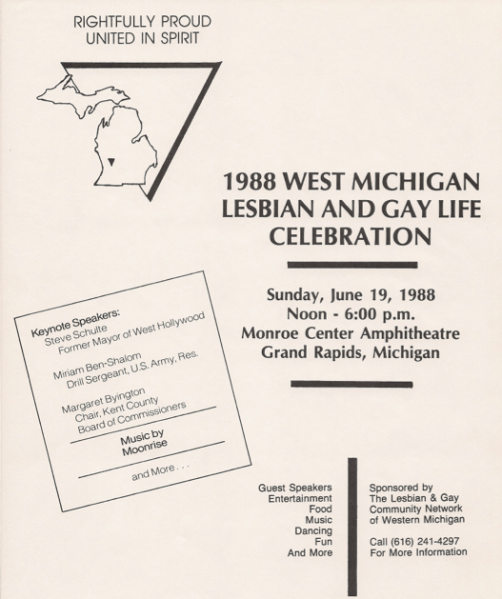 This all began to change in the 1980s, when members of the LGBTQ community began to organize and to fight back against homophobia. Based on dozens of interview we did for a documentary on the LGBTQ community in Grand Rapids, the catalyst for getting organized was in 1988, when people from Grand Rapids went to the march in Washington DC. Motivated by their experience at the march, local members of the LGBTQ community formed the Lesbian and Gay Network, which began working on numerous issues, like organizing a Pride Celebration in Grand Rapids.
The first Pride Celebration was held in June of 1988, although the Mayor of Grand Rapids would not support the event, nor provide a declaration for the event, even though Mayor Helmholt had written proclamation for the following events the same year – Michigan Beverage News Week, Family Sexuality Education Month, Polish Heritage Month, National Roofing Week and Bozo Show Day. Mayor Helmholt did deny another group a proclamation, a neo-Nazi group that was hosting an event in Grand Rapids that same year.
 The Network was also working on the issue of HIV/AIDs, since the disease had already impacted so many members of their community. The national LGBTQ movement had forced the Reagan Administration to create an AIDS Task Force, but many of the members of the Task Force were anti-gay, like Rich DeVos, the co-founder of Amway. Years later, it was reported what DeVos thought about his time on the AIDS Task Force saying:
When HIV first came out, President Reagan formed a commission and I was honored to be on that commission. I listened to 300 witnesses tell us that it was everybody else’s fault but their own. Nothing to do with their conduct, just that the government didn’t fix this disease. At the end of that I put in the document, it was the conclusion document from the commission, that actions have consequences and you are responsible for yours. AIDS is a disease people gain because of their actions. It wasn’t like cancer. We all made the exceptions for how you got it, by accident, that was all solved a long time ago. That’s when they started hanging me in effigy because I wasn’t sympathetic to all their requests for special treatment. Because at that time it was always someone else’s fault. I said, you are responsible for your actions too, you know. Conduct yourself properly, which is a pretty solid Christian principle.
Bruce Roller, a Christian Pastor and a member of the LGBTQ community said that there was tremendous bias towards those with AIDS, and a great deal of ignorance. Roller said that medical staff would not touch AIDS patients, nor bring food into their rooms. Many ambulance companies and funeral homes also refused services to those who had AIDS or who had just died from AIDS.
Beginning in the early 1990s, the LGBTQ community also took on the task of changing the City’s anti-discrimination ordinance, to include sexual orientation to the list of things that people could not be discriminated on. Members of the Network did letter writing campaigns, public educational forums and kept going to the City Commission meetings demanding a change.
In 1992, the first of several public hearing were held on the anti-discrimination ordinance. Lots of people from the LGBTQ community spoke in favor of the ordinance change, but there were also numerous people, mostly claiming to be Christians, who spoke out against the proposed ordinance change, often using religious texts to justify their position. Grand Rapids, and West Michigan as a whole, was deeply opposed to LGBTQ inclusion, but it is also important to note that many of the wealthiest families in the greater Grand Rapids area also funded numerous anti-Gay groups in Michigan and across the US.

Despite the opposition, in 1994, after a two year campaign, The Network was able to get enough votes for the City Commission to adopt a revised version of the anti-discrimination ordinance, which would include protections against discrimination for sexual orientation.
With the examples I have provided, the very notion of democracy has always been in peril and it has always been evolving, especially when some of the most vulnerable communities began to demand equate treatment.
In my research into the history of what is now called Grand Rapids, I believe that democracy has always been limited and in turmoil and that only when social movements have organized to confront systems of power and demand changes, has any real notion of democracy been practiced.
 Grand Rapids Institute for Information Democracy
Comments are closed.