Deconstructing the Grand Rapids Chamber of Commerce reasons for endorsing the GRPS November bond vote
Some three weeks ago, parents, students and community members came out to an event being held by the Grand Rapids Public Schools. It wasn’t a protest per say, since the group was in full support of the November bond vote for the GRPS, but that they wanted to make sure that GRPS Administration and the School Board would prioritize funds for very specifics issues that are based on what the community is demanding. You can read about those demands at this link.
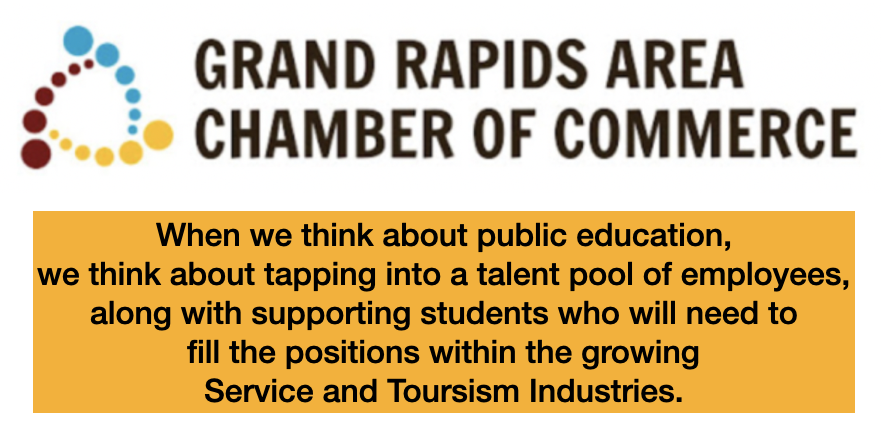
On October 2nd, the Grand Rapids Chamber of Commerce announced that they were endorsing the GRPS bond vote on November 7th. The GR Chamber states in their announcement the following:
GRPS is seeking voter approval of a 20-year, $305 million bond proposal to fund capital, technology and security projects.
- The bond is the same rate as the 2004 & 2015 bonds, 3.85 mills.
- Educational building construction, consolidation improvements, renovations of auditoriums and athletic facilities, technology upgrades, playground improvements, and safety & security improvements will be paid for with the bond.
- GRPS buildings are currently at 51% utilization for student capacity. This proposal will allow GRPS to consolidate educational space and will alleviate an estimated $145 million in deferred maintenance costs.
It is important to note here that what the GR Chamber of Commerce is claiming the money will be used for does not align with what the Urban Core Collective’s Education Justice campaign is calling for.
Equally important are the two talking points that the Grand Rapids Chamber of Commerce provide on the GRPS Bond vote.
- A stable, strong and growing GRPS will retain and attract families, talent and job providers in Grand Rapids. They need 21st infrastructure to make this a reality and the business community urges support.
- Chamber leadership will continue to engage with GRPS on improving outcomes and how school property can best be utilized if no longer needed.
These two talking points are instructive, plus anyone who cares about the future of public education should be rather concerned about what the influential business entity thinks about public education.
The Grand Rapids Chamber of Commerce supports the GRPS bond vote because they want to, “retain and attract families, talent and job providers in Grand Rapids.” Strange, I always thought that public education at the K – 12 level was an opportunity to not only assist students to learn, but to teach critical thinking and further develop in students a curiosity about their community, their country and the world.
What the GR Chamber of Commerce wants to see out of the GRPS is to provide a talent pool for the businesses they represent, plus a steady stream of working class people who can fill positions in the service industry. This fits the two tiered system that the GRPS has, where “more talented” students go to places like City High, while students who are less likely to go to college, can take classes to be part of the Hospitality and Tourism industries.
The second point, where the GR Chamber will, “engage with GRPS on improving outcomes and how school property can best be utilized if no longer needed.” Could this be because GR Chamber members like Rockford Construction are always looking at getting contracts with the GRPS or working with other developers to turn former GRPS facilities into apartments or condos?
Lastly, while I understand that people might think that the Grand Rapids Chamber of Commerce endorsement of the bond vote in November is a good thing, it ignores their stance on other critical issues. Within the past year, the Grand Rapids Chamber of Commerce has initiated and supported the criminalization of the unhoused in Grand Rapids, and has opposed many of the recent legislative efforts in Michigan to move the economy in a more just fashion. This is why we need to see the GR Chamber’s endorsement of the bond vote as nothing more than looking out for their own interests, where students are seen as talent, rather than as critical thinking members of the community.
 Grand Rapids Institute for Information Democracy
Comments are closed.