An opportunity to promote a living wage campaign in Grand Rapids and other economic justices demands
There is proposed legislation in Lansing right now, legislation that would lift the ban on what is now referred to as the Local Government Labor Regulatory Limitation Act. According to an analysis of Senate Bill 0171:
The Local Government Labor Regulatory Limitation Act, prohibits a local governmental body from regulating the employment relationship between a nonpublic employer and its employees. Among other prohibitions in the Act, a local governmental body may not require an employer to pay an employee a wage higher than the State minimum hourly wage or other fringe benefits, regulate strike activity, or regulate an employer’s hours or scheduling of employees.
If Senate Bill 0171 were to be adopted it would provide greater opportunities for workers and the communities they live in to earn higher wages, have better benefits and allow workers to engage in more militant strikes, moving from symbolic picketing to wildcat strikes.
Of course, there are organizations within the State of Michigan that are opposing this legislation, along with several groups from West Michigan. The Michigan Chamber of Commerce crafted a letter opposing SB 0171, with dozens of organizations signing on to the letter. Among those groups that are from West Michigan, are the Grand Rapids Chamber of Commerce and the West Michigan Policy Forum.
The West Michigan Policy Forum released their own statement on why SB 0171 should be opposed, with the claim that, “ life will get more expensive, and jobs will disappear across our state.”
Similar legislation was proposed in the State House of Representatives back in March. However, the State House version of the proposal hasn’t received the same kind of attention as the Senate version of the bill.

An opportunity to adopt living wage standards
If SB 0171 and HB 4237 were to be adopted, it would merely lift the ban on these critical labor issues. However, the real work would be at the municipal level, which could then make decisions on adopting living wages and other more radical labor demands.
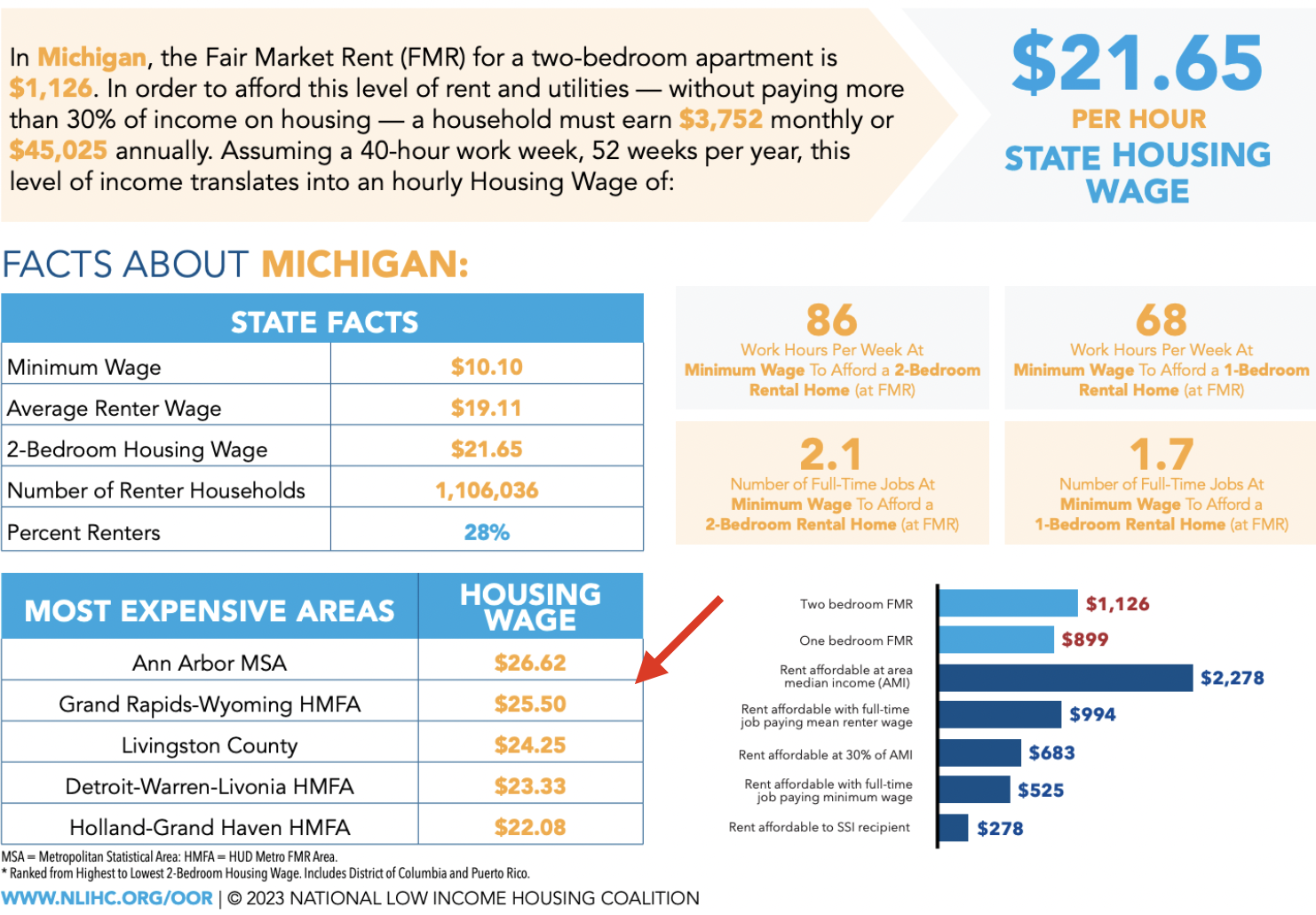
One way to think about this, as it relates to wages in Grand Rapids, is to think about what it costs for people to rent in this city currently. According to the National Low Income Housing Coalition, for the average person in Grand Rapids to afford rent in this city, they would need to earn an hourly wage of $25.50, for 40 hours. Therefore, a minimum wage for Grand Rapids should be $25.50 an hour, but a living wage should probably be $30 – $35 an hour.
If Grand Rapids is organized and people can create an economic justice working group to make this kind of a demand around wages, along with other demands for workers, then the proposed legislation would be a good thing. You can bet that the Grand Rapids Chamber of Commerce and other members of the Capitalist Class will oppose such things, plus they already have a cozy relationship with Grand Rapids City officials, so it will definitely be a fight to win economic justice policies and a living wage campaign in Grand Rapids.
However, it should be noted that throughout history, that battles over wages and other economic justice benefits have come about because of struggles won by labor unions and other economic justice centered groups. In fact, improved wages and benefits have always been won by campaigns organized by working class people. Even if the proposed legislation does not get adopted, workers can get organized in any sector to make demands and win economic justice battles for their families and communities.
 Grand Rapids Institute for Information Democracy
Comments are closed.