UAW workers go on strike: Celebrating the legacy of UAW organizing in Grand Rapids
The current UAW workers strike is being called historic, especially since it is the first time that unionized workers in all three of the auto companies have been on strike together.
Alex Press, writing for the Jacobin, says that the UAW workers strike should matter to all working class people in the US. Press writes, “The entire working class will be watching to see if autoworkers can claw back decades of concessions and win a transformative contract.”

To honor this historic strike by UAW workers, we thought it would be important to provide some background on the history of UAW organizing in Grand Rapids, particularly after the Great Depression. What follows is an except from chapter 3 of my book, A People’s History of Grand Rapids.
Pushing Grand Rapids Left
Still reeling from their defeat during the 1911 furniture workers strike, Grand Rapids unions were not effectively mobilized to respond to the growing power of industrial capitalists. However, the insurgent labor organizing by the UAW and the CIO provided new inspiration and new opportunities for workers to challenge the business community in Grand Rapids.
In the Spring of 1937, the UAW called for strikes at the Robert Irwin Co., the Macey Co., and Irwin Seating, all based in Grand Rapids, which involved roughly 1,000 workers over a five-week period. In September of that same year, more strikes would break out at the Furniture Shops of America, John Widdicomb, Grand Rapids Chair, and other furniture factories in the area. In each of these instances the union won a closed shop contract guaranteeing to hire only union workers. The unions also won a check-off procedure, meaning union dues would be automatically deducted from the pay of authorizing employees, and, perhaps the cause of the most celebration to many of the workers, they won wage increases.
After a failed attempt to organize a union at the Kelvinator refrigerator and domestic appliances plant, the UAW tried again in 1937 and won their first contract, which included the recognition of the union and wage increases. Known as Local 206, this UAW organizing effort became a model for many of the other labor organizing efforts across the city of Grand Rapids. In some cases, workers defied local courts’ anti-picketing injunctions, and many workers went to jail for brief periods in order to win labor contracts and build worker power from the ground up.
While most of the labor organizing in Grand Rapids involved walk-out strikes and picketing that made significant gains, workers at the Atwood Brass Works held a wildcat strike and factory occupation that lasted for three days, following Flint’s example.
The radical direct-action efforts of the workers in Flint scared the business community enough to be willing to negotiate with angry workers in Grand Rapids out of fear that a wildcat strike might break out here. When people engage in radical direct action it pushes everything to the left. Workers in Grand Rapids were able to seize the moment created by the wildcat strike in Flint and mobilize workers (that had been labeled as “not radical enough” and “conservative”) to demand their rights and to unionize several thousand workers over the next several decades.
After the UAW and the CIO began organizing in Grand Rapids, union membership grew significantly. Yet union leadership at the national level made a deal with business leaders and the Roosevelt administration. The result was that the unions agreed to not strike while the US was involved in World War II.
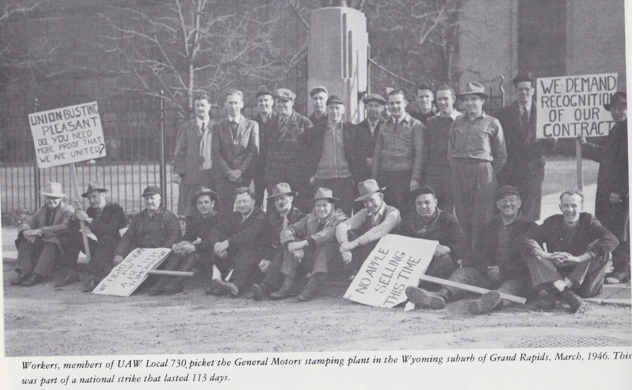
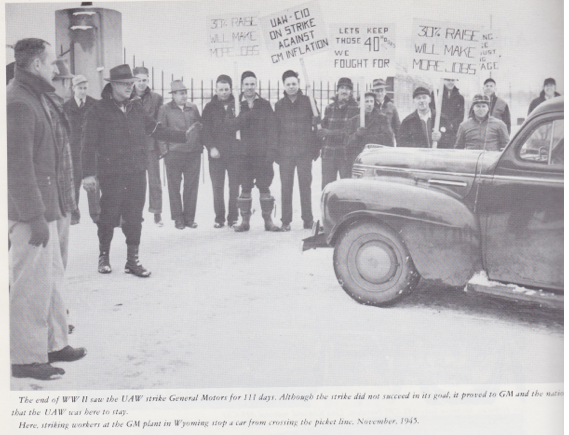
Despite the no-strike pledge, union membership in the US grew from 7.2 million in 1940 to 14.5 million at the end of WWII. The strikes began almost the moment that the bombs stopped dropping on Japan. In September 1945, 43,000 petroleum workers and 200,000 coal workers went on strike. In October, 44,000 lumber workers, 70,000 teamsters, and 40,000 machinists joined them. Then in November 1945, the UAW called its first major strike against GM since the company was unionized in 1937. Nearly a quarter of a million men walked out. Grand Rapids saw the same dynamic: workers who experienced years of frustrations during the no-strike pledge of WWII began to challenge the capitalist class by engaging in walkouts and strikes. In 1946, workers at the UAW Local 730 at the GM plant in Wyoming, Michigan were part of the national UAW strike that lasted for 113 days. The UAW striking workers were fighting for better wages, pensions, and improved working conditions, all of which were denied them during the no-strike pledge of WWII.
What this brief history of UAW organizing in Grand Rapids reveals to us is that working class people must always remain vigilant in the fight against the Capitalist Class, especially since they are relentless in their efforts to exploit workers whenever they can in order to increase profits for the owners and the shareholders.
 Grand Rapids Institute for Information Democracy
Comments are closed.