On Wednesday, I was invited to speak to a group of GVSU students about the history of Environmental Movements in Grand Rapids
My presentation to the students was a sorter version of chapter 8 in my book, A People’s History of Grand Rapids. Many thanks to the GVSU professors who invited me to speak, specifically Professor Melba Velez Ortiz. Mil Gracias!!!!
Like all cities, Grand Rapids has its own history of environmental destruction. An example of this can be seen quite simply, and possibly innocently, in the former title of Grand Rapids being the “Furniture City.” To look underneath this name, however, reveals the productive necessity of clearcutting trees in West Michigan, in northern Michigan, and as far away as parts of northwestern states, this according to records documenting from where the furniture barons of Grand Rapids were importing lumber.
We could also talk about the increased levels of industrial pollution that ended up in the Grand River, since a great deal of industry was positioned along the river for decades. In addition, we could identify the increased use of automobile use in Grand Rapids, which later resulted in the construction of US 131 and 196 highways that intersect near downtown Grand Rapids.
The recognition of the increasing levels of air pollution, water pollution, industrial waste and other consequences of industrialization and hyper-consumerism, eventually led to a growing awareness that the destruction of ecological systems would result in our own destruction as human beings.
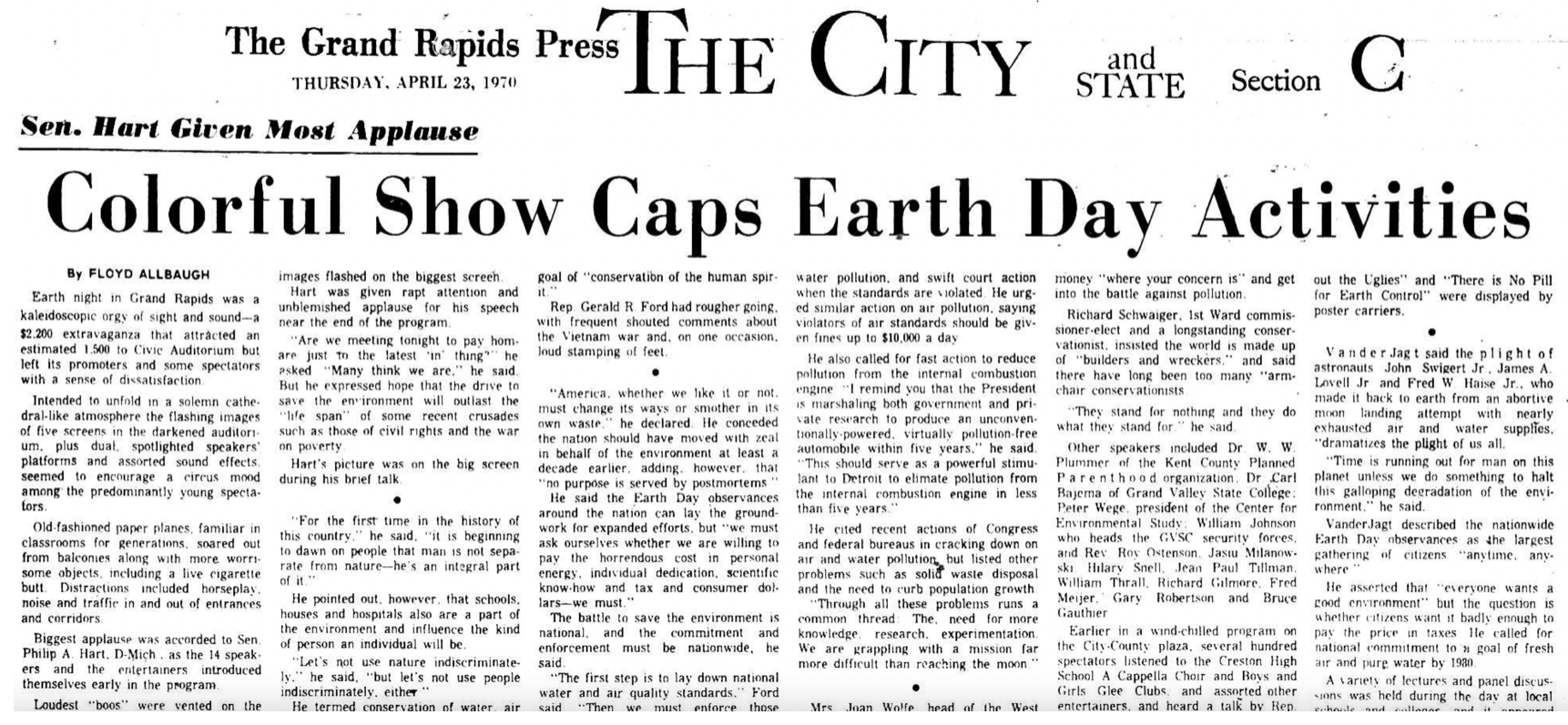
The First Earth Day took place in communities all across the US in April of 1970, including right here in Grand Rapids. There were several events/actions that took place on that day in 1970, which in many ways would set the tone for the future of the environmental movement.
In the afternoon, there was an event with song and signs at the Calder Plaza, with the featured speaker being Rep. Guy VanderJagt, a Republican from Cadillac. The comments by VanderJagt, as reported in the Grand Rapids Press, spoke of the urgency to take action. However, the representative from Cadillac framed the environmental urgency in terms of how much people would be willing to pay in taxes to get clean air and clean water.
There was also a large community event, with an estimated 1,500 people in attendance at the Civic Auditorium in the evening. The event featured images on the big screen, musicians and speakers, including Rep. Gerald Ford. When Ford spoke, he received boos, loud comments about the war in Vietnam and sometimes Ford’s comments were greeted with loud stomping of feet. According to the GR Press, Ford suggested that we need to make personal sacrifices, including consumer spending and taxes. Ford also suggested that people should “reduce pollution from the internal combustion engine.” He claimed that President Nixon, along with the private sector, would be creating a “virtually pollution-free automobile within five years.”
Besides the two informational/educational events, there was also a student-led protest at a Grand Rapids meat factory. Students from Grand Rapids Junior College chose to protest at a meat factory because of the pollution the business was emitting as a result of how the company cured the meat. The factory had been the target of complaints from neighbors for years because of the pollution. One student who was interviewed in the Grand Rapids Press stated that the protest was not singling out this particular factory. It was to protest air pollution in general. One of the signs that was used during the protest read, “Smoking Killed Hogs Brings Killing Smoke Smog.”

This last action, organized by students, is more reflective of the kinds of actions people were taking across the country, which focused attention on corporate pollution or structural pollution. In fact, in its early years, Earth Day actions were either to engage in collective projects that would promote ecological sustainability or to confront those most responsible for environmental destruction, such as the corporations and militarism.
From that first Earth Day in 1970 to the present, those involved in doing environmental work have either focused on personal lifestyle choices, voting or on whatever the non-profit environmental groups were involved. However, this is not what social movements are traditionally centered around. Movements challenge systems of power and oppression that are the root cause of the problems that a movement choses to address.
There have also been greater efforts to organize around Food Justice work, especially in the past 20 years, organizing that was born out of an Environmental Justice Movement framework. In addition, there has been organizing to fight for climate justice, most recently from student-led efforts like the Sunshine Movement. Climate Justice organizing has taken on numerous forms in the past 20 years, but one example of this organizing that is worth looking at was the anti-fracking movement. The anti-fracking movement is certainly one component of the larger Climate Justice Movement. This movement begins around 2010 and owes some of its expansion to the documentary film Gasland, by Josh Fox.
Deep hydraulic fracturing became a technological process being used by the fossil fuel industry, which allowed corporation to drill deeper than normal in search of methane gas that was trapped in the earth. The technique of fracking opened up new possibilities for corporations to extract gas, which also led to a mad scramble to either purchase land or to lease land from the state.
Beginning in late 2011 in the Grand Rapids area, people began to meet and talk about forming an autonomous group that would promote and practice radical environmentalism. This group, who later called themselves, Mutual Aid GR, first crafted their own organizing document, which not only provided their framework for organizing, but also provided analysis on larger areas of concern such as food, transportation and energy.
Shortly after producing this document, Mutual Aid GR hosted their own People’s Assembly for Radical Sustainability. This event was designed to not only create more conversation around critical environmental issues, but to build a greater capacity for doing the necessary organizing work in Grand Rapids. By the fall of 2012, the group already organized its first major action coinciding with the International Day Against Fracking, which was action at Wolverine Oil & Gas, a local company that had a history of fracking. Three members of Mutual Aid GR occupied the offices of Wolverine Oil & Gas and were later arrested by the GRPD. The group released a statement, which in part read:
“Today, we occupy the offices of Wolverine Oil & Gas as one action against the consequences of oil and gas extraction in Michigan. We are confronting Wolverine Oil & Gas because they have a history of profiting from environmental destruction and particularly their use of the natural gas extraction method known as hydraulic fracturing.
We are occupying Wolverine Oil & Gas to demand that they release all information about the type and amount of chemicals they have used in fracking to date and the amount of water used; to release information on the location of all oil and gas wells they own and operate in Michigan, and to stop the practice of fracking where ever they engage in this practice.
No Compromise in Defense of Mother Earth!”
A month after the Wolverine Oil & Gas occupation, Mutual Aid GR began doing research into companies that were applying for land leases in order to engage in fracking. The group found that there were some large multinational corporations that had already entered into lease agreements in Kent County, such as Shell Oil, AMOCO, Uniroyal Inc., and Western Land Services.
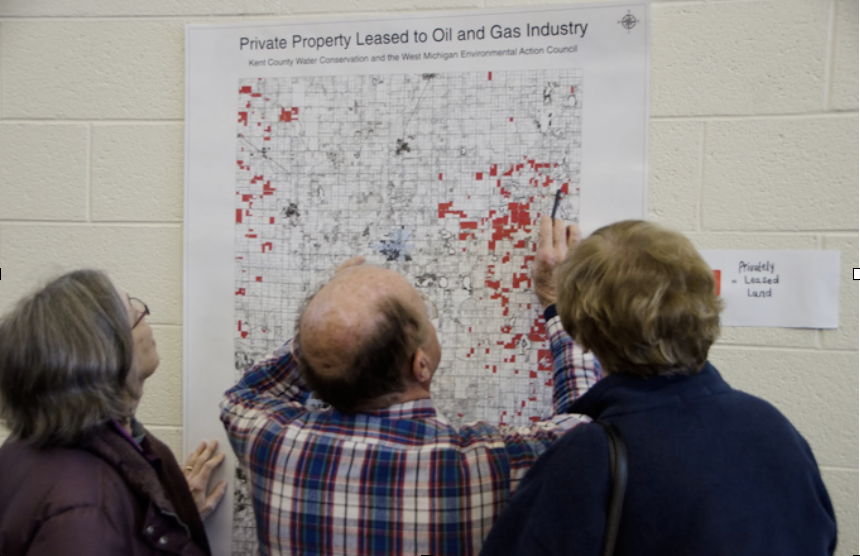 In the same month that Mutual Aid GR was researching land leases in Kent County for fracking, the Michigan Department of Natural Resources (DNR) hosted one of its bi-annual auctions for leasing mineral rights for oil & gas companies across the state in Lansing. Mutual Aid GR and other radical environmental groups decided to attend the state auction, with the goal of trying to prevent the State of Michigan from leasing land to oil & gas companies who wanted to engage in fracking.
As people were entering the room where the state land auction was being held, they had to pass by a crowd of people lined up with anti-fracking signs. In addition to those who protested outside, some people released a banner that was attached to balloons inside, while others who sat in the room where the auction was taking place began to disrupt the meeting by making statements. At one point, several people stepped over the divider separating the public seating and the bidder seating, locked arms and sat on the floor in an act of civil disobedience. Simultaneously, there were some noise tools released to disrupt the auction and then the whole room began chanting in opposition to fracking and the arrest of those who sat down.
Mutual Aid GR continued organizing educational events and participating in direct action against the fracking industry for another 12 months after the actions in Grand Rapids and Lansing. However, they eventually folded. Yet, before they folded, they were instrumental in getting the largest environmental non-profit in Grand Rapids, WMEAC, to finally take a public stance against hydraulic fracturing.
 Grand Rapids Institute for Information Democracy
Comments are closed.