Commercial Media source MLive shockingly frames the potential UAW strike as “bad for the economy”
This coming weekend is Labor Day in the United States, and while people will be having cook outs and going camping, it is always an important time for people to reflect on who actually creates wealth in this world, the workers. Therefore, today’s post will center workers, more specifically the United Auto Workers.
A little more than a week ago, MLive posted an article with the following headline, UAW strike against Big Three could cause over $5B in economic losses, report finds.
The article is primarily about the report, which was conducted by the Anderson Economic Group, which represents corporations, which also includes the auto companies that the UAW would be striking against.
Thus, the Anderson Economic Group is cited in the early part of the article, followed by a comment from US President Joe Biden, who is calling for the UAW and the auto companies to come to a settlement. Towards the end of the article, the President of the United Auto Workers, Shawn Fain, is cited as well, where he states:
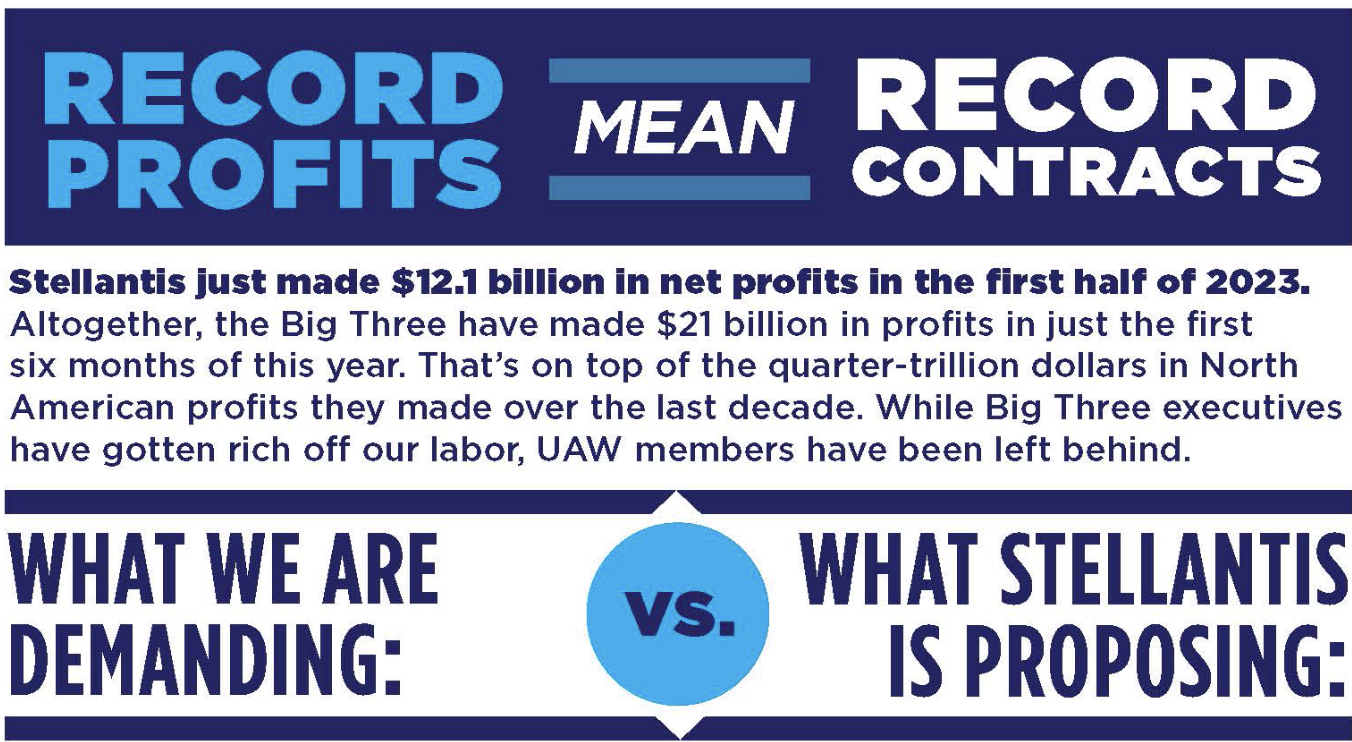
company executives for taking in a reported $21 billion in combined profits while “workers who spent long hours wrecking their bodies on the line” struggle with long hours and low wages.
To be clear, the Big 3 automakers made $21 Billion in combined profits just in the first six months of 2023 alone.
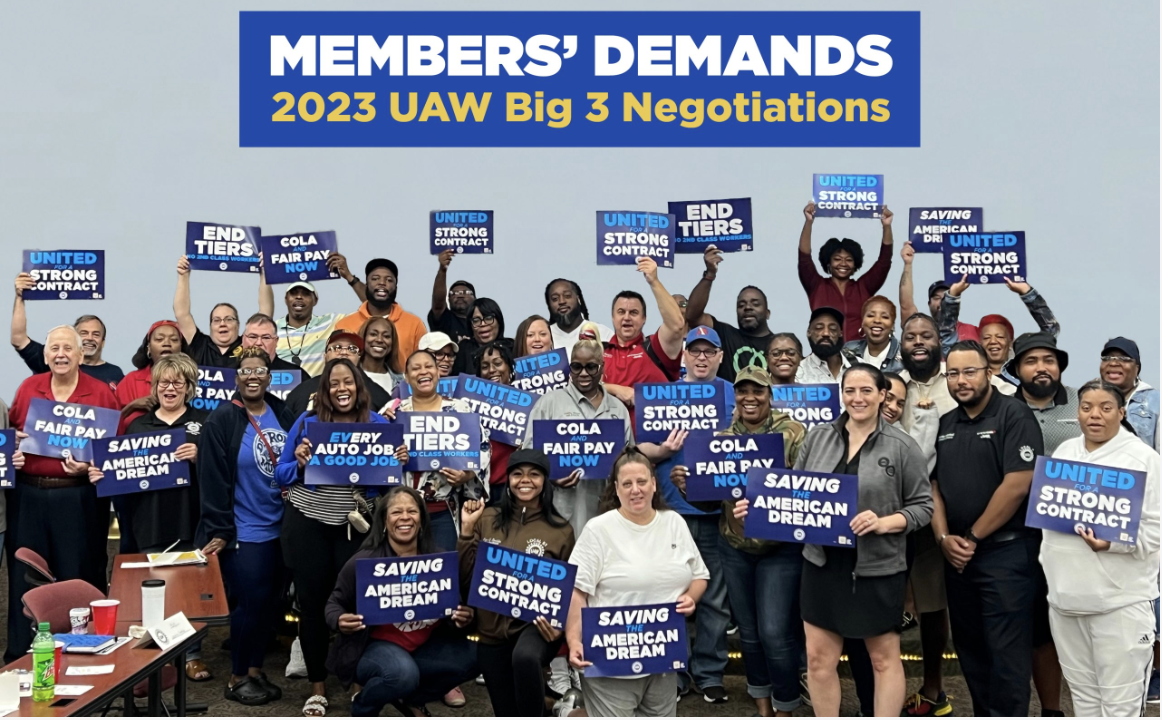
Now, what is missing from the MLive article, is probably the most relevant aspect of the potential strike that the UAW might engage in……..a list of what their demands are. According to a recent post from the group Labor Notes, the demands include:
- Eliminating tiers on wages and benefits, plus double-digit raises for all
- Restoring cost-of-living adjustments, which were suspended during the Great Recession
- Restoring the defined-benefit pension and retiree health care for all; workers hired since 2007 have neither
- Increasing pensions for current retirees; there’s been no increase since 2003
- The right to strike over plant closures
- A “working family protection program.” If the companies shut down a plant, they would have to pay laid-off workers to do community service work.
- Making all current temps permanent employees, with strict limits on the future use of temps
- Increasing paid time off
One additional demand centers on the issue of Electric Vehicle (EV) production. Again, Labor Notes shares some important content from the UAW on EV production, stating:
The union is simultaneously pushing to improve conditions for electrical vehicle (EV) battery workers employed at joint ventures between the Big 3 and South Korean firms. A letter signed by 28 Senators urged the companies to fold these battery workers into their master agreements with the UAW. “These are highly skilled, technical, and strenuous jobs,” read the letter. “It is unacceptable and a national disgrace that the starting wage at any current American joint venture EV battery facility is $16 an hour.”
The companies say these proposals are too expensive and threaten their competitiveness, especially when they are ramping up investment to convert to EVs. Fain says this argument ignores recent history: “When the Big 3 say the future is uncertain and the EV transition is expensive, remember that they’ve made a quarter of a trillion in North American profits over the last decade and have poured billions of it into special dividends, stock buybacks, and supersized executive compensation.”
This last demand around EV production and wages is an important one. As a recent Jacobin article pointed out:
Eliminating tiers is the highest priority for many workers. What this means in practice is a bit complicated, especially on the electric vehicle (EV) front. Some EV construction now happens under joint-venture projects like Ultium (General Motors and LG), but tiers under preexisting UAW contracts are already fulfilling much of our EV work. With potentially dozens of battery plants being planned and built in the United States alone, however, that may be changing.
One thing is clear: the elimination of joint-venture battery tiers as well as all other tiers is necessary for a just transition to green manufacturing and infrastructure. Fighting climate change must not come at the expense of workers’ livelihoods — we all deserve the same rights, benefits, and pay won at the bargaining table.
Another aspect of EV production, as it relates to Michigan, is the fact that the State of Michigan is providing an estimated $1.63 Billion in subsidies for EV battery production, which GRIID wrote about earlier this year.
With Labor Day coming up in the next week, it is critical that we think about the realities that working class individuals and families face in the current Neoliberal Capitalist economy. Centering the voices and lived experiences of workers in vital, especially if we hope to develop a greater sense of solidarity with people.We can’t expect the commercial news media to make worker’s lives relevant, which is exactly why we need to seek out other sources of information, and in this case, particularly information coming from the Labor Press. Solidarity Forever!
Check out more information on UAW worker demands at this link.
 Grand Rapids Institute for Information Democracy
Comments are closed.