I was invited to talk a little Grand Rapids People’s History during an East Hills Council of Neighbors walking tour on Monday night
 This past Monday, I was invited by one of the East Hills Council of Neighbors staff (big shout out to Jessica Young) to share some People’s History that was specific to that neighborhood.
Like all neighborhoods, there is a tremendous amount of history that has to do with social movement work, and the East Council of Neighbors area is no different.
Vietnam War Resistance
I began by talking about two houses that were involved in organizing and resistance work during the Vietnam War. On the 300 block of Charles Street, there was the Hennacy House, named after Ammon Hennacy, a writer, pacifist, Wobblie and part of the Catholic Worker Movement.
The Hennacy House was a community house, but it also was a place where anti-war organizing/planning took place, along with people who were trained to do Conscientious Objection trainings. During the Vietnam War, there was still a draft, but people had options of either leaving the country, resisting the draft (which often led to jail) or to become a Conscientious Objector (CO). One of the people deeply involved with the CO work was Jasiu Milanowski. Jasiu’s bother, Paul Milanowski, is a Catholic Priest, who was also active in anti-war work.

On the 300 block of Henry Street, there was another Catholic Worker house, the Grimke House, named after the 19th century abolitionist Grimke sisters. The Grimke House was also involved in anti-war resistance during the Vietnam era, along with being a house of hospitality for the unhoused.
The Central American Sanctuary Movement
The Grimke House shut down eventually, but other people took over and made it another community house for a few years, until 1987, when they sold it to the Koinonia House, which became a Sanctuary House in 1986. The Koinonia House was located on LaGrave Avenue SE, but just months after several Guatemalan families arrive in 1987, the Koinonia House used the house on Henry as a Sanctuary House. In fact, one of the original families that was in sanctuary, still lives in that house and has used it as place for new Guatemalans who arrive in West Michigan and needed a place to stay until they could get settled.
A Safe Haven for the LGBTQ community in Grand Rapids
The last part of the segment of the East Hills Neighborhood tour that I was on, had to do with a bookstore/cafe that existed in the 1990s called Sons and Daughters. Sons and Daughters was started Jeff Swanson and Dennis Komack, a couple that had moved to Grand Rapids from San Diego.Dennis was hired by the Grand Rapids Art Museum in the mid-1980s.
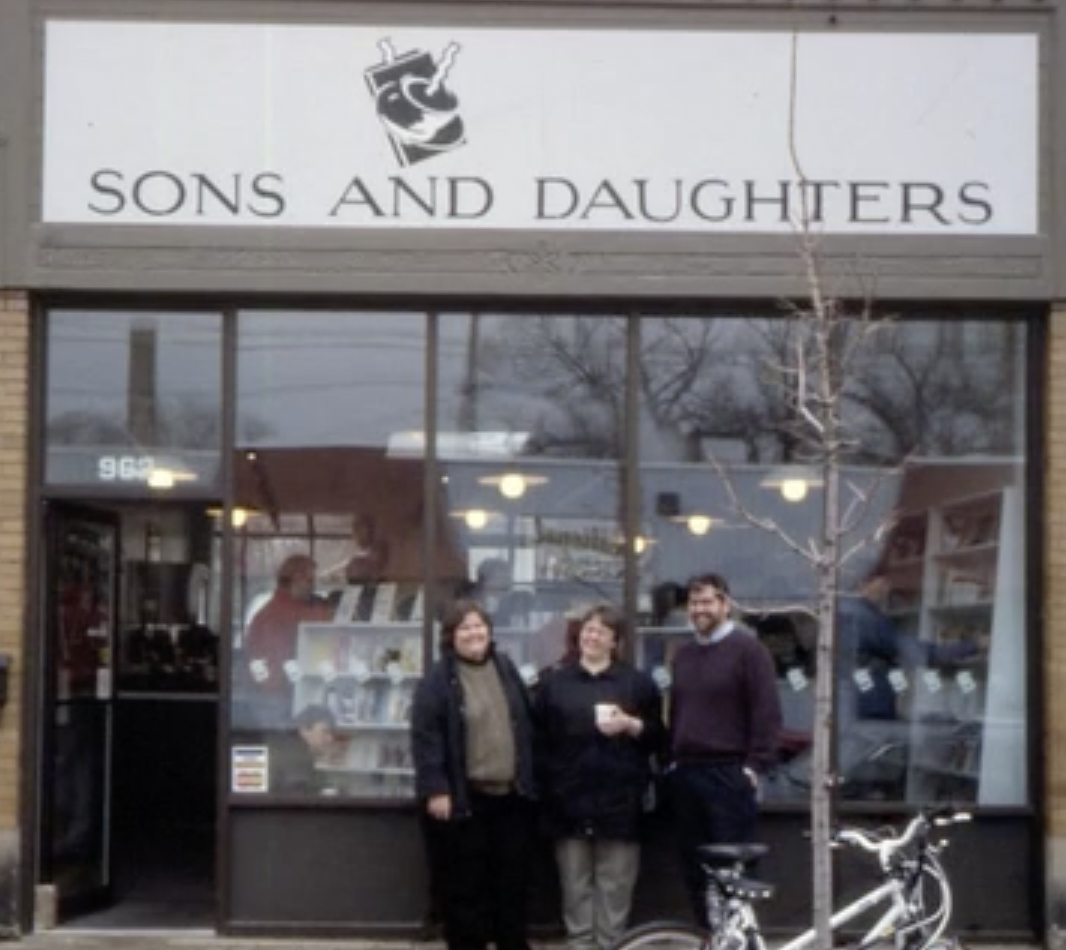 When we were making the documentary about the LGBTQ community in Grand Rapids in 2011, one thing we kept hearing about was the gay bookstore/cafe, Sons and Daughters. People talked about how it was one of the few safe spaces for people who identified as part of the LGBTQ community, apart from several bars in town. People also talked about the important role that this bookstore played, especially for those who just coming out. Sons and Daughters was not only a safe space, but it was a place where people could go and learn about the history of the LGBTQ movement, along with meeting other people and connecting to other resources in the community. To listen to people share stories about Sons and Daughters, go to this link to watch A People’s History of the LGBTQ Community in Grand Rapids. The section on Sons and Daughters begins at 1:01:10.
Our film about the history of the LGBTQ community in Grand Rapids was first screened in October of 2011, on the downtown campus of GVSU in the Loosemore Auditorium. Over 700 people came out to watch the film and we received a standing ovation when the film was over. However, not everyone was happy with the film.
The very next day, the GVSU LGBT Resource Center got a call from legal counsel for GVSU. The lawyer told a staff member at the LGBT Resource Center that they needed to change some of the content in the film. As we mentioned earlier, Dennis Komack was a co-owner of Sons and Daughters, while he was working for the Grand Rapids Art Museum. His partner, Jeff Swanson, shared with us that Dennis was told by the President of the Board at the Art Museum that if he did not disassociate himself from the bookstore, that he would lose his job. Dennis refused and he was fired. The person who delivered the ultimatum was Kate Pew Wolters. The reason that the lawyer called and demanded to have the filmed changed is because in 2011, GVSU was doing a capital campaign to raise money for a new library that would be called the Mary Idema Pew Library. Mary Idema Pew was the mother of Kate Pew Wolters and the lawyer felt that since Dennis Komack was fired by Kate Pew Wolters, that it might threaten the fund raising efforts of the new library. We refused to alter the content of the film and the new library at GVSU was built.
In reflecting on my small role at Monday night’s East Hills Neighborhood walking tour, realized once again how important the history from the ground up is in any community. Thinking about this gave me some additional inspiration and excitement for our event on September 23rd, when we are doing A Radical Walking Tour of Grand Rapids. We hope you can join us.
 Grand Rapids Institute for Information Democracy
Comments are closed.