Faux News, Structural Racism and the perpetuation of White Supremacy in Grand Rapids
There are plenty on news entities that exist in the greater Grand Rapids area, many of which GRIID has monitored over the past 25 years.
With the digital age of journalism, the amount of news has grown exponentially, but such growth hasn’t often resulted in more drive-by journalism, journalism that doesn’t hold systems of power accountable, and journalism that provides little or no historical context.
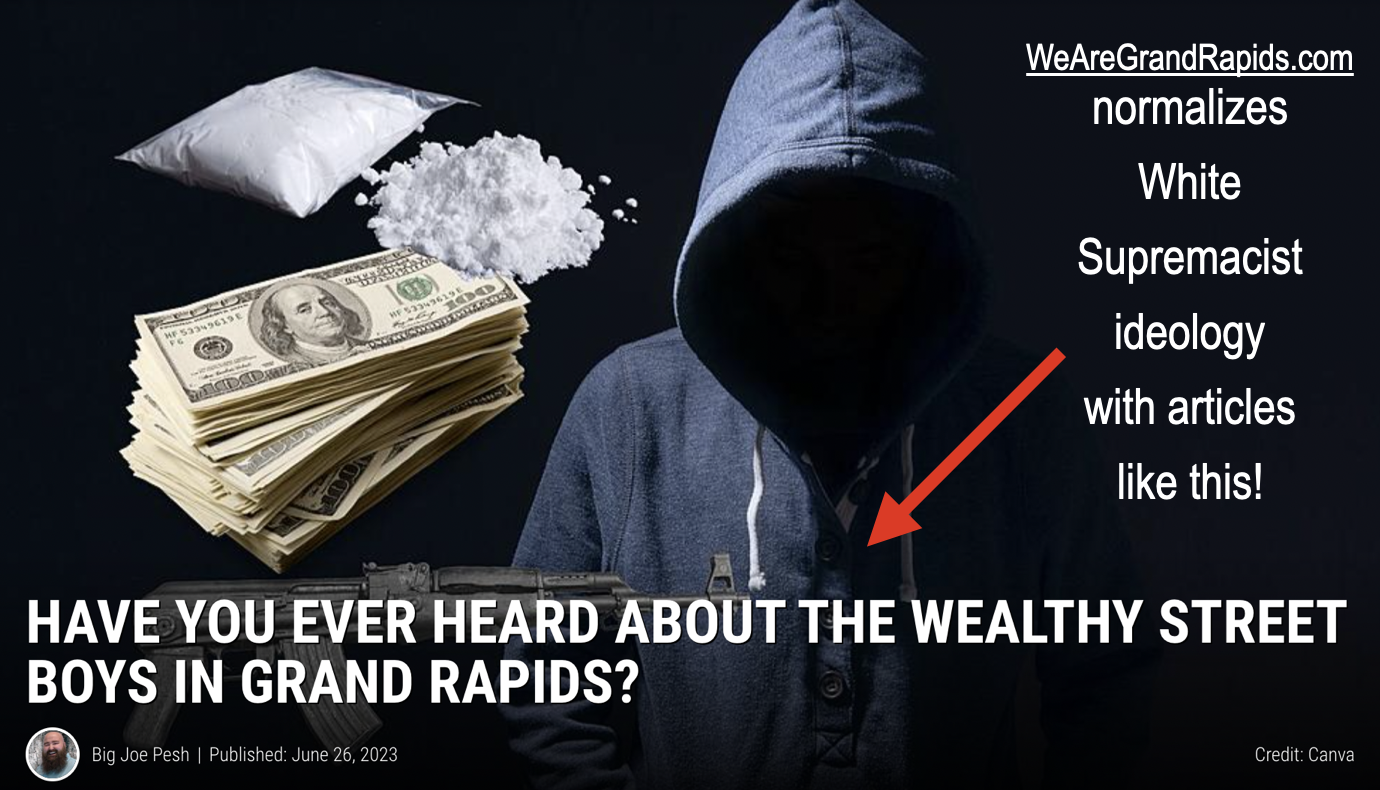
How many people have heard of wearegrandrapids.com? It is a more recent local “news” entity that practices drive-by journalism, which is journalism that tries to get clicks and rarely provides any follow up stories or contextual information. wearegrandrapids.com is owned by Town Square Media, a media conglomerate that is the largest owner of radio stations in the country, with 357 radio stations and 74 websites like wearegrandrapids.com.
Yesterday, wearegrandrapids.com post such a story, entitled, Have You Ever Heard about the Wealthy Street Boys in Grand Rapids? The article is written by Joe Pesh, who is an on air personality for WGRD radio. He has no formal training in journalism and his story is primarily based on stories that Joe’s wife’s uncle told him when he was a patrol officer with the GRPD in the 1990s. In addition, the images used with the story are nothing more than stills taken from a WOODTV8 news clip from 1997.
The article was essentially a joke by any reasonable journalistic standards. However, what the article actually does is to first, normalize White Supremacist ideology, and secondly, to engage in historical revisionism, by presenting a Black gang that dealt crack cocaine as nostalgia.
Both of these dynamics are deeply problematic. The story normalizes White Supremacy, since it presents mostly images of Black people who fit all the stereotypes about that most white people believe when it comes to drugs and Black people. Even asking the question, Have You Ever Heard about the Wealthy Street Boys in Grand Rapids?, reflects a White Supremacist ideology, since the writer had no intention of discussing the larger historical context about the very existence of a Black gang in Grand Rapids.
When it comes to historical revisionism, the post on wearegrandrapids.com fails to explore a who range of issues that would be extremely relevant to our collective understanding on the larger War on Drugs in the US that began with the Nixon Administration. For those wanting to explore more deeply how the US War on Drugs was designed to specifically target Black communities, with a strategic plan to expand the use of state violence against the Black population, then read Clarence Lusane’s book, Pipe Dream Blues: Racism and the War on Drugs.
In addition, it is vitally important that we understand the larger context of why there was a Black gang on Wealthy Street in the late 1990s in the first place. Here are some of the major contributing factors:
- During the 1960s, and especially after the 1967 riot in Grand Rapids, white people were leaving the urban core of Grand Rapids in large numbers. This resulted in a massive disinvestment in neighborhoods that had become predominantly Black.
- The US economy had become de-industrialized, especially beginning in the 1970s and culminated with the passing of the North American Free Trade Agreement (NAFTA) in 1994, which has resulted in massive job displacement, which Public Citizen has documented.
- Part of the massive dis-investment in the urban core was caused by white flight, but it was also the result of the 1995 ballot initiative in Grand Rapids to increase the number of cops and to provide even more of the City’s budget to the GRPD. This meant that a minimum of 33% of the City’s budget would now be spent on policing.
- Members of the Grand Rapids Power Structure wanted to make downtown Grand Rapids a tourist destination. There became a massive effort to “revitalize” downtown, an effort that was largely led by the DeVos family and led to the creation of Grand Action in the early 1990s to design development projects that those with deep pockets would primarily benefit from. The first project was the Van Andel Arena.
- In 1996, the Clinton Administration functionally ended welfare as we know it, by signing into law the Personal Responsibility and Work Opportunity Reconciliation Act. This policy was designed to force people who were utilizing the state’s safety net to get work, which resulted in the perpetuation and expansion of poverty in the US, particularly in BIPOC communities.
Therefore, when you dismantle much of the manufacturing sector, reduce government assistance, disinvest in Black neighborhoods and increase the number of cops and budgets for policing, you will create a cause and effect dynamic that both forces people into illegal means of making money, and a justification to punish them at the same time. All of this should be understood as Structural Racism in Grand Rapids, which I discuss in Chapter 2 of my book, A People’s History of Grand Rapids.
 Grand Rapids Institute for Information Democracy
Comments are closed.