3rd Anniversary of the Uprising in Grand Rapids – Violence against property vs Structural Violence
It has been three years since thousands of people rose up against police violence in Grand Rapids, which was just one of the hundreds of protests that took place across the globe after a Minneapolis cop killed George Floyd.
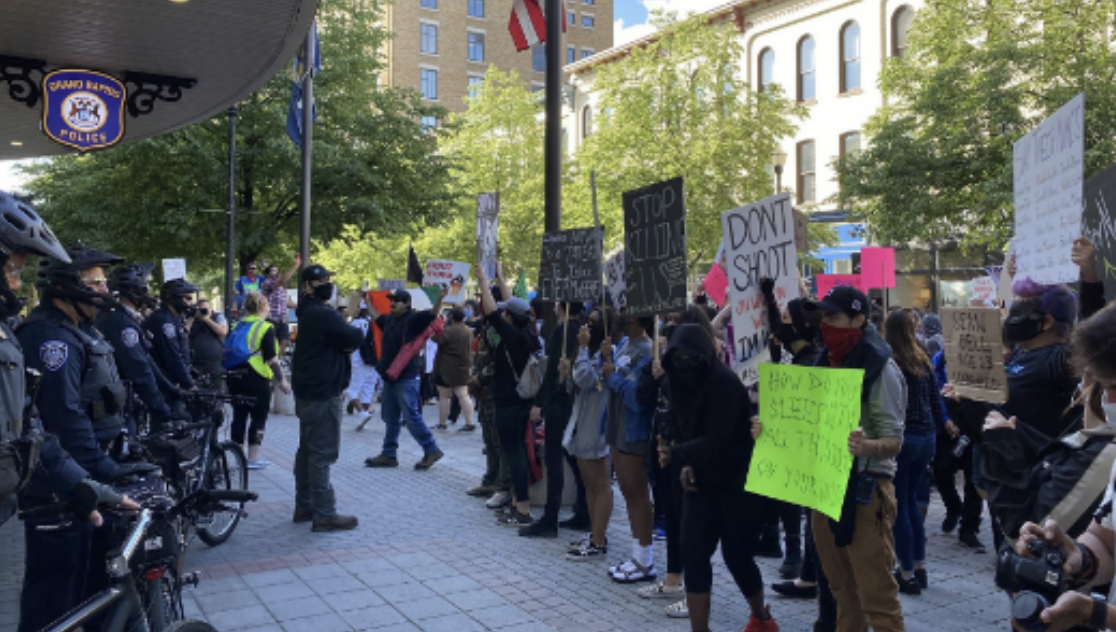
From the very beginning, Grand Rapids City officials sought to control the narrative about what happened on May 30th, 2020. Those with political power sought to demonize those who engaged in property destruction and differentiate peaceful protesters from violent protestors.
In addition, for the first time since the 1967 riot, Grand Rapids City officials called for a curfew and brought in the Michigan National Guard to protect property in the downtown area. In addition, the Grand Rapids-based commercial news media also mimicked the government narrative, elevating government, police and business voices over those who took to the streets during the uprising. On top of that, members of the Grand Rapids Power Structure also used the May 30th uprising as an opportunity to engage in their own form of propaganda.

In a Grand Rapids Business Journal article on June 1st, Sam Cummings, one of the partners with CWD, provided his reaction to Saturday’s uprising in Grand Rapids. The article was entitled, CWD Real Estate sees silver lining in aftermath of violent protests, with Cummings stating:
Sam Cummings, managing partner with CWD, said he was “mad as hell” Saturday night and Sunday morning, but witnessing the community outreach and cleanup afterward restored his faith in West Michigan.
“That is not who we are, and that was confirmed by talking to some folks on the police force,” Cummings said. “Who we were was (Sunday).”
“The peaceful gatherings are a justified, honorable and rightful thing to have occur,” Cummings said. “Those things should be protected, but when they escalate to damaging small businesses — we got guys who have had their entire inventory wiped out — when they escalate to damaging other people’s property or their employees, it’s not acceptable.”
GRIID wrote a response to the bullshit that oozed from the mouth of Cummings in an article entitled, One of the biggest looters in Grand Rapids has a problem with the recent protests.
Over the past three years, these kinds of narratives have dominated any and all discussion about the 2020 uprising in Grand Rapids, always making sure that the attention centers on the issue of property destruction as opposed to the structural violence that exists in Grand Rapids, particularly for Black, Indigenous and other commentates of color. Even Grand Rapids Police Chief Eric Winstrom, even though he did not get hired until 2022, has made it a point to frame the 2020 uprising as a violent protest, such as he did in an interview this part March.

Property Destruction vs the daily forms of structural violence in Grand Rapids
Before we talk about Structural Violence in Grand Rapids, it is important for us to establish a working definition of what Structural Violence is. One of the best definitions I have come across is from an online site called Structural Violence. Here is their definition:
“Structural violence is one way of describing social arrangements that put individuals and populations in harm’s way… The arrangements are structural because they are embedded in the political and economic organization of our social world; they are violent because they cause injury to people … neither culture nor pure individual will is at fault; rather, historically given (and often economically driven) processes and forces conspire to constrain individual agency. Structural violence is visited upon all those whose social status denies them access to the fruits of scientific and social progress.”
Now that we have a working definition of structural violence, lets look at ways in which structural violence manifests in Grand Rapids, especially when, historically given (and often economically driven) processes and forces conspire to constrain individual agency.
- There are a handful of billionaires in GR, along with one quarter of the population living in poverty. One example is from an article we wrote pointing out how the wealth of Hank and Doug Meijer grew by $6.7 Billion in the first 18 months of the pandemic, while thousands in Grand Rapids became even more impoverished.
- There are thousands of people who don’t make a living wage and can’t afford the cost of rent in most neighborhoods. We point this form of structural violence in an article entitled, The un-affordability of housing in Grand Rapids.
- Thousands of families are food insecure in Grand Rapids and have little or no health insurance. The structural violence of food insecurity is stark in Grand Rapids and is often perpetuated by food charity groups that do not address the root causes of hunger and food insecurity.
- There are countless families who have to decide on paying rent each month or paying their utilities, transportation or health care costs. This kind of structural violence is one of the more insidious forms of violence, where people are forced to make these kinds of difficult decisions.
- People who still live in places with lead-based paint or lead in their drinking water, is also a manifestation of structural violence.
- People who can’t afford to own a car and who don’t have a bus route near their place of residence is a form of structural violence, since limited mobility options are by design.
- People who are forced to live near the City owned incinerator, a toxic waste site or other areas that disproportionate have more pollution is form of structural violence, often called environmental racism.
- People who can’t find work or a place to live because of a past criminal record. When people are marginalized because of criminal history, they are not afforded a second chance and end up in a cycle of structural violence.
- People who live in neighborhoods that are disproportionately policed by the GRPD. As Alex Vitale, author of The End of Policing makes clear, “The origins and function of the police are intimately tied to the management of inequalities of race and class. The suppression of workers and the tight surveillance and micromanagement of race and class. The suppression of workers and the tight surveillance and micromanagement of black and brown lives have always been at the center of policing.”
- Black, Brown, Indigenous and other communities of color that face structural racism on a daily basis is a manifestation of structural violence.
Ok, so here are just 10 ways in which Structural Violence exists in Grand Rapids. At this point we should ask ourselves, if Grand Rapids City officials really want to reduce violence, and why is the GRPD not policing or arresting employers who don’t pay a living wage, landlords who exploit tenants, businesses that pollute the water, air and soil, those who control a food system which keeps people malnourished and sick, billionaires for being, well billionaires, and politicians who vote on policy that benefits the rich and punishes working people, especially BIPOC people?
Aren’t all of the things I have listed an urgent, daily form of violence that plagues our communities? Why is the GRPD not urgently trying to figure out ways to stop these forms of violence? Two reasons. First, because the GRPD, which is part of the system of power and the enforcement mechanism of state violence, doesn’t care about Structural Violence, they only want to respond to street level violence, because it disrupts business as usual. Second, the GRPD will not stop structural violence because it is by design. Think about it. Every time workers go on strike, the cops are there to protect the company or corporation. Every time there is a protest against landlords or property management companies, the cops are always there to protect landlords and property management companies. Every time there is protest against an oil pipeline that will run through Indigenous land, the cops are always there to protect the oil companies. Every time there is a protest against corporates that knowingly pollute, the cops are there to protect the corporations from the public. Cops don’t give a shit about the every day violence that is structural, because that is not their function within the system of power they operate in. We should never expect this dynamic to change, which is exactly why the GRPD should be defunded and abolished. #Justice4Patrick
Additional Sources:
The George Floyd Uprising, edited by the Vortex Group
No More Police: A Case for Abolition, by Mariame Kaba and Andrea Ritchie
In Defense of Looting: A Riotous History of Uncivil Action, by Vicky Osterweil
After Black Lives Matter, by Cedric Johnson
 Grand Rapids Institute for Information Democracy
Comments are closed.