The continued sanitizing of Dr. King by the local press
As the country prepares to celebrate Dr. Martin Luther King’s birthday, everyone with their own agendas tends to come out and use the memory of the slain civil rights leader for their own purposes.
A few years ago Glen Beck organized an event on the anniversary of the 1963 March on Washington and many social conservatives will often misuse Dr. King’s comment about judging people not by the color of their skin, but by the content of their character.
However, social conservatives are not the only ones who misuse the memory of Dr. King. We often see social liberals use King in very sanitized, self-serving ways.
Such was the case in a January 15 story on MLive. The article focuses on what three local African Americans have to say about how to achieve Dr. King’s dream of equality. The Press reporter never really clarifies what was meant by King in terms of equality and presents each of the three responses as in step with what Dr. Martin Luther King Jr. preached.
What is particularly problematic about the article was the focus on black businesses, being entrepreneurs, development and preparing youth to “survive in the work world.” The comment about black businesses came from the head of the Black Chamber of Commerce, the statement about development came from a City Commissioner and the comment about youth surviving in the work world was from the acting superintendent of Grand Rapids Public Schools.
While one could certainly argue that King supported more Black economic autonomy and independence, he more often spoke about economic justice and against poverty. This is not the focus of the Grand Rapids Black Chamber of Commerce, as we noted in an article in September.
Ironically, although much of the emphasis is on economics, not much of what was said reflects the analysis that Dr. King provided during his life, particularly during the last few years of his life.
First, King recognized that the poverty that befell Americans, particularly Black Americans, is based on a history of exploitation.
“No amount of gold could provide an adequate compensation for the exploitation and humiliation of the Negro in America down through the centuries. Not all the wealth of this affluent society could meet the bill. Yet a price can be placed on unpaid wages. The ancient common law has always provided a remedy for the appropriation of the labor of one human being by another. This law should be made to apply for American Negroes. The payment should be in the form of a massive program by the government of special, compensatory measures, which could be regarded as a settlement in accordance with the accepted practice of common law. Such measures would certainly be less expensive than any computation based on two centuries of unpaid wages and accumulated interest. I am proposing, therefore, that just as we granted a GI Bill of Rights to war veterans, America launch a broad-based and gigantic Bill of Rights for the Disadvantaged, our veterans of the long siege of denial.” (Why We Can’t Wait)
In addition to King’s version of reparations, the slain civil rights leader was also critical of free market capitalism:
“We are now making demands that will cost the nation something. You can’t talk about solving the economic problem of the Negro without talking about billions of dollars. You can’t talk about ending slums without first saying profit must be taken out of slums. You’re really tampering and getting on dangerous ground because you are messing with folk then. You are messing with the captains of industry….Now this means that we are treading in difficult waters, because it really means that we are saying that something is wrong…with capitalism…here must be a better distribution of wealth and maybe America must move toward a Democratic Socialism.”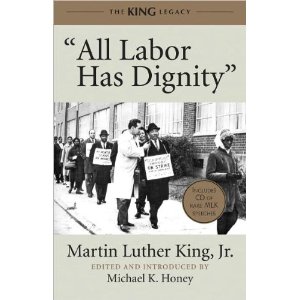
King’s critique of capitalism and the growing wealth gap in the US led him to support worker rights campaigns, which is well documented in Michael Honey’s recent book, “All Labor Has Dignity.” This support for workers led him to Memphis in April of 1968 to support sanitation workers who were striking for better work conditions and pay. King was also in the midst of an organizing effort to confront the federal government’s failure to defend American families it what was known as the Poor People’s Campaign.
None of this kind of analysis and advocacy on behalf of the poor is reflected in the comments by those cited in the MLive story. The lack of substantive commentary is disappointing as is the failure of the Press reporter to question how the sources comments were consistent with Dr. King’s notion of equality.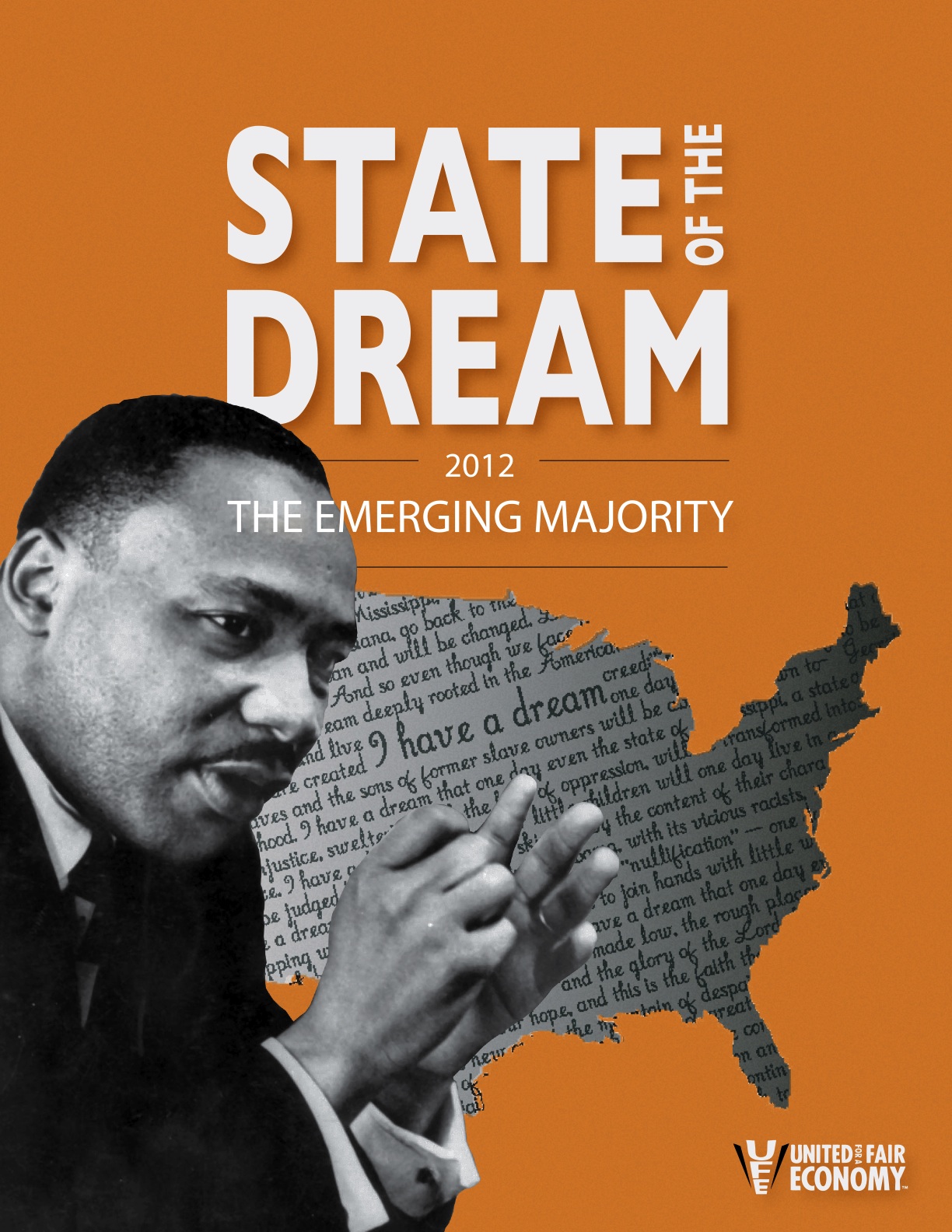
Lastly, it should be noted that the group United for a Fair Economy has just come out with their annual State of the Dream Report. In the 2012 report, which looks at the wealth divide in the US along racial lines, the authors identify four roadblocks to achieving Dr. King’s Dream.
- Disparities in income perpetuate poverty in communities of color and will continue to do so unless change is made.
- Increasing wealth inequality entrenches the racial economic divide.
- Education is one of the most important tools we have for increasing social mobility, yet dramatic disparities in education perpetuate inequality.
- The mass incarceration of people of color is historically unprecedented.
Imagine if the Press reporter had known about this report or familiarized herself with what Dr. King really stood for. How would that have changed the content and what would be the benefit to the West Michigan community?
 Grand Rapids Institute for Information Democracy
How can you expect the Press to address these issues? The Press sells newspapers to a white market. For the most part, this segment will continue to see “Dr.” King as merely a black minister who was fighting for the black. As history is revisited, the truth of this man’s depth intellegence will be revealed as human compasionate about the upliftment and humility of humankind. I wrote a letter to the editor of the press a few years ago regarding the shallow celebration of the press’ month long reporting of Black History Month. I wa accused of being an angry black man by Mike Lloyd. Dr. King, as well one of his inspirations, Marcus Garvey, malcolm X expressed the essential goal of self-esteem in elf-determination and sufficiency
How can you expect the Press to address these issues? The Press sells newspapers to a white market. For the most part, this segment will continue to see “Dr.” King as merely a black minister who was fighting for the black. As history is revisited, the truth of this man’s depth intellegence will be revealed as human compasionate about the upliftment and humility of humankind. I wrote a letter to the editor of the press a few years ago regarding the shallow celebration of the press’ month long reporting of Black History Month. I wa accused of being an angry black man by Mike Lloyd. Dr. King, as well one of his inspirations, Marcus Garvey, malcolm X expressed the essential goal of self-esteem in elf-determination and sufficiency.
Brenda, I don’t expect the GR Press to address these issues for the reasons you stated. However, if they are going to continue to claim that they practice journalism then it is our view that we need to continue to hold them accountable for such claims. In addition, the analysis provides an opportunity to present the real message and actions of Dr. King and the Civil Rights/Black Power movement.