Climate Summit Day 5: Corporate Clowns, Militarism and Carbon Trading
Active resistance to the countries of the world that refuse to significantly reduce carbon emissions and those that promote reformist positions continued at the United Nations Climate Summit in Durban, South Africa.
Activists and organizers recognize that part of the problem with a lack of any substantive change in global carbon reduction is that financial institutions still fund projects that are inherently built on ecological destruction and growth.
The World Bank is one of the main culprits in the financing of global warming, so people occupied the World Bank meeting that was taking place at the Climate Summit. The occupation was led by activists dressed as clowns, which called themselves Corporate Clowns. Armed with noisemakers the clowns called for the World Bank to get out of Climate Finance. The clowns issued a statement that read in part as:
“The role of private investment in financing climate activities must be decided at the national and sub-national levels in line with countries’ priorities, not corporate bottom lines. The move to allow the private sector to go directly to the Green Climate Fund for money undermines the possibility of a democratic, participatory process for meeting the needs of communities struggling to fight climate change.”
Some good analysis articles have also surfaced in the past day. One of those stories was from Reuters, which pointed out that there are many countries who have bought into the notion that nuclear energy is safe and a viable way to reduce coal consumption.
Another solid article can be found on Science for Peace, written by Patricia Hynes. Her article looks at how militarism is one of the main global warming culprits. Here are some alarming facts Hynes presents:
- The projected full costs of the Iraq War (estimated $3 trillion) would cover “all of the global investments in renewable power generation” needed between now and 2030 to reverse global warming trends.
- Between 2003-2007, the war generated at least 141 million metric tons of carbon dioxide equivalent (CO2e)4, more each year of the war than 139 of the world’s countries release annually.5 Re-building Iraqi schools, homes, businesses, bridges, roads, and hospitals pulverized by the war, and new security walls and barriers will require millions of tons of cement, one of the largest industrial sources of greenhouse gas emissions.
- In 2006, the U.S. spent more on the war in Iraq than the entire world spent on renewable energy investment.
- By 2008, the Bush administration had spent 97 times more on military than on climate change. As a presidential candidate, President Obama pledged to spend $150 billion over 10 years on green energy technology and infrastructure — less than the United States was spending in one year of the Iraq War.
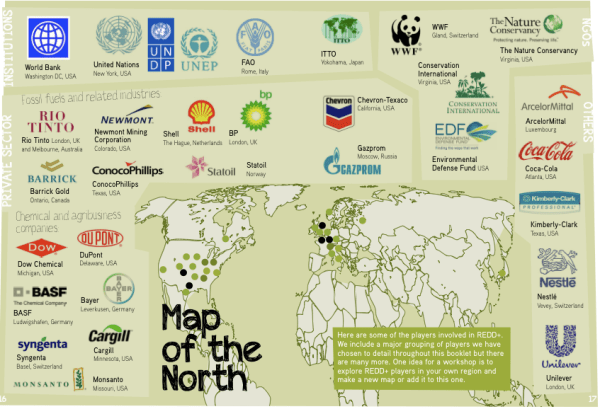

We also came across some amazing educational resources for anyone wanting to do climate justice work. The first is a great online zine that identifies those who benefit from the UN program known as REDD – Reducing Emissions from Deforestation and forest Degradation. While the name sounds like it is committed to climate justice, indigenous groups and farming communities around the world have exposed REDD as another corporate-friendly project. The Indigenous Environmental Network and Carbon Trade Watch have put together this fabulous resource, which you can download here.
Lastly, there is an amazing documentary called The Carbon Connection, which takes a close look at the fallacy of carbon trading. Carbon trading is just another scheme by global capitalists to keep polluting and pretend to actually reduce carbon emissions. You can watch the film online here.
 Grand Rapids Institute for Information Democracy