This Day in Resistance History: Happy Birthday, Ogden Nash
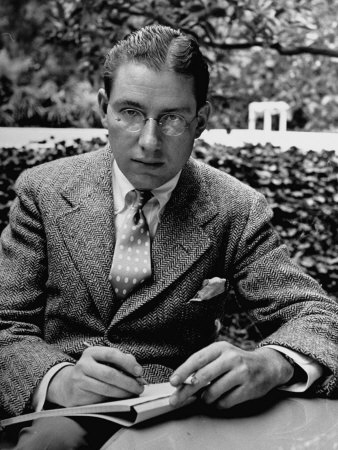
Why include a light-hearted versifier like Ogden Nash in our resistance history review? There was a deeper side to a man whose poems were considered throw-away verse during their time. Those who can quote Nash’s witty short poems such as “Candy is dandy/But liquor is quicker” and his ode to the common cold often don’t realize that during his life, Nash openly pronounced the two-party political system as a fraud. He was also scathing in his assessment of the elite, corporations, and the corrupting influence of advertising.
Born on August 19, 1902, to a family originally from the South (Nashville was named after one of his ancestors), Nash was born in New York. He spent the better part of his adult life sneaking groundbreaking political thinking into his popular light verse. Some academic studies have compared him to political satirist Jonathan Swift. As one critic commented, “It would be a mistake to think of Ogden Nash merely as a funnyman…he has a Democritean streak which entitles him the respect due to a philosopher.”
Look at this take on the two-party system, excepted from Nash’s poem “The Politician”:
Behold the politician.
Self-preservation is his ambition.
He thrives in the D. of C.
Where he was sent by you and me.
He has many profitable hobbies
Not the least of which is lobbies.
He would not sell his grandmother for a quarter…
If he suspected the presence of a reporter.
He gains votes ever and anew
By taking money from everybody and giving it to a few
While explaining that every penny
Was extracted from the few to be given to the many.
Some politicians are Republican, some Democratic,
And their feud is dramatic,
But except for the name
They are identically the same.
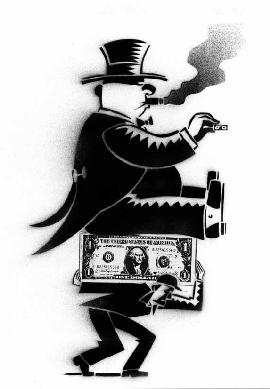
In a poem titled “Bankers Are Just Like Everybody Else, Only Richer,” Nash exposes the cold heart of the banking system: to cooperate with the wealthy and exclude the poor from its services. He comments that in a bank’s “marble halls” it is impossible for someone to take out a loan for $50 to pay a hospital bill or back rent because “you must never lend any money to anybody unless they don’t need it.” But the scenario changes when a rich person enters the bank:
But suppose people come in and they have a million
And they want another million to pile on top of it.
Why, you brim with the milk of human kindness
And you urge them to accept every drop of it.
And you lend them the million so then they have two million
And this gives them the idea that they would be better off with four.
So, they already have two million as security so
You have no hesitation in lending them two more.
And all the vice presidents nod their heads in rhythm,
And the only question asked is do the borrowers want the money sent or do they
want to take it with them.
Nash’s poem “Lines Indicted with All the Depravity of Poverty” admits to some envy of those who have unlimited funds but takes a razor-sharp swipe at the indifference of the elite as they “spend money like water”:
If you are rich you don’t have to think twice about buying a judge or a horse,
Or a lower instead of an upper, or a new suit, or a divorce,
And you never have to say “when”
And you can sleep every morning until nine or ten.
He was keenly aware of the other side of the coin: the inequity dealt to the working class in their jobs. When asked to sum up working life by one interviewer, Nash said, “People who work sitting down get paid more than people who work standing up.” His focus on the unfair advantages of white-collar work is also found in this pithy two-line poem:
Professional men, they have no cares.
Whatever happens, they get theirs.
Media and advertising were other targets for Nash’s scorn. He hated the pervasiveness and influence of advertising. He once noted that in our modern life, nothing had value except products. He quipped that, as a poet, he was therefore valueless:
Poets aren’t very useful
Because they aren’t consumeful or produceful.
Here’s Nash’s dry commentary on the wasted money that is poured into promoting products:
Good wine needs no bush
And perhaps products that people really want
need no hard-sell or soft-sell TV push.
Why not?
Look at pot.
He complained about the ubiquitous highway billboards of the 1930s in his short parody of Joyce Kilmer’s poem:
I think that I shall never see
A billboard lovely as a tree.
Indeed, unless the billboards fall
I’ll never see a tree at all.
Found among Nash’s many verses on social life, marriage, children, and health problems are a surprising number of poems about political life, social justice issues, and the grip capitalism has in deciding the fate of the many for the benefit of the few. He honed his views through observation rather than current events; Nash hated reading newspapers. One of his most famous non-verse comments, in fact, is one that still resonates with perfect clarity today:
“I do not like to get the news, because there has never been an era when so many things were going so right for so many of the wrong people.”
 Grand Rapids Institute for Information Democracy
Dear Kate, the words you write for GRIID
Don’t bring you that much fame.
However they elucidate the ruling classes’ games.
The sentences you string along
Don’t bring you any money.
The topics, grim and serious, aren’t very often funny.
The paragraphs you post each day
won’t bring you any cash.
They do keep people’s history from ending in the trash—
today you really made my day—
A fan of Ogden Nash!
Stelle, your talents fantastic
Are truly elastic:
From reporting to comment
With observational content…
But I never imagined
That with pen so impassioned
Your Stellar communications
Included Nash-ification!
Thanks for the compliment…and for the verse. It made my day!
Awesome poetry you two above, amazing how times are so similar to the beginning of the last century.