The Meaning of Bastille Day
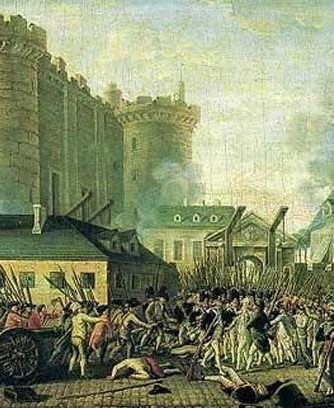
Today is le quatorze juillet, the French national holiday which English-speaking people call “Bastille Day.” This celebration marks the day in 1789 when French peasants and the workers of Paris stormed the King’s prison. By doing so, they symbolically rejected the monarch’s power and authority over the lives and welfare of his subjects. Although only seven prisoners were freed in the bloody battle, afterward an army of peasants destroyed the prison itself. This symbolic act sparked the true beginning of the French Revolution. It created a platform for the people’s Declaration of the Rights of Man. It also launched the “reign of terror,” a period of time when aristocrats who had subjected peasants and farm workers to poverty and slave-like working conditions were put to death on the guillotine.
The clueless King Louis XVI had gone hunting that 14th of July and wrote the word “nothing” as his diary entry—meaning he had not bagged any game. When he heard about the destruction of the Bastille, Louis asked an advisor if the act could be considered a revolt. The minister replied, “No, Majesty—this is a revolution.”
Today, the 1789 toppling of elitist power is celebrated throughout France and particularly in Paris. A parade down the Champs-Elysees is a popular event. A spectacular fireworks display in the evening is televised across the nation. People in towns and villages hold dances to memorialize the revolutionaries, who broke into spontaneous dancing when their siege of the prison was successful. French families often put together “peasant” meals on which to picnic: rustic bread, cheeses, wine, and clafoutis, a bread pudding made with cherries.
But not everyone in France celebrates Bastille Day. Wealthy French families, particularly those with titles, often quietly leave Paris and even France, vacationing in Tuscany or Seville until the holiday is over. The reason is obvious: as the descendants of the courtiers and aristocrats who once held all of France’s power, they would be participating in celebrating the beheadings of their own ancestors. Le quatorze juillet serves as a yearly reminder of the power of a united working class, something that many upper-class French would prefer to forget.
In recent years, conservative French politicians have joined in this snubbing of Bastille Day to cater to their elitist base. The most visible boycotter is France’s current president, Nicolas Sarkozy.
Sarkozy, a hyper-conservative, has attempted since his election to shift power to capitalists and the wealthiest French citizens via policies that include the cutting of worker health care, the lengthening of work weeks without additional pay, and the raising of the retirement age. He has launched anti-immigration policies and advocates for stronger homeland security. He has also declared that France, a republic, is intended to be a “Christian nation.” Under this rationalization, Sarkozy has acted against French Muslims by attempting to take over Islamic mosques and place them under government control. He has labeled protesters against his policies “thugs” and “scum.” Many of his policies and beliefs will be familiar to Americans: here, a similar agenda is supported by conservative elements like the Tea Party, the Koch Brothers, the DeVos and Prince families, and Snyder’s Mackinac Center-fueled regime in Michigan.
Traditionally on Bastille Day, the French president participated in three events: a garden party for his political supporters; a speech to the people of France (similar to the U.S.’s state of the nation speech); and the public pardoning of prisoners. Sarkozy continues to hold the garden party. But he has refused to give the speech or to pardon any prisoners since his election in 2007. These choices send a message to his wealthy and titled supporters about his alliance with the elite and his lack of interest in the working-class citizens of France.
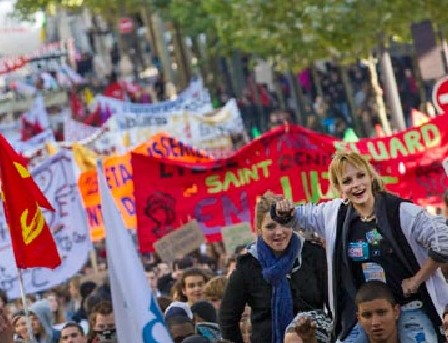
But far from being successful in launching Draconian policies in his country, Sarkozy has been met at every turn by strong resistance. Parisian streets have been swamped with workers who went out on general strikes to protest the lengthening of the work week. In 2009, hundreds of thousands of workers protested Sarkozy’s policies to aid capitalists instead of ordinary French citizens duriug their “economic crisis.” An article in the UK’s Guardian explained:
Train drivers, airport staff, teachers, postal workers and tax inspectors joined private-sector employees including bank clerks, car workers, ski-lift operators, supermarket check-out staff and even employees from the company that operates France’s stock exchange [are all participating]…With lawyers and journalists from state TV and radio also walking out, the various groups are protesting for job protection and better wages and against a raft of Sarkozy’s reforms, ranging from justice to hospital and school reforms, and changes to the running of state TV.
Another paralyzing strike by transportation workers occurred in 2010, and a huge general strike protesting the raising of the retirement age shut down high schools across France, as students took to the streets to show solidarity with workers. These and other general strikes have drawn the approval of up to 70 percent of French citizens, with a conservative minority of 30 percent consistently against—a breakdown of power brokers versus workers that is similar to the one in this country.
Why have the French been so successful in their resistance, while in America we allow a minority to continue transferring public wealth in to private hands?
Perhaps one reason is Bastille Day: a celebration which reminds people across France that they have destroyed an elitist, authoritarian power base before…and they can do it again.
 Grand Rapids Institute for Information Democracy
Trackbacks