This Day in Resistance History: To Burn or Not to Burn…That is the Flag Day Question
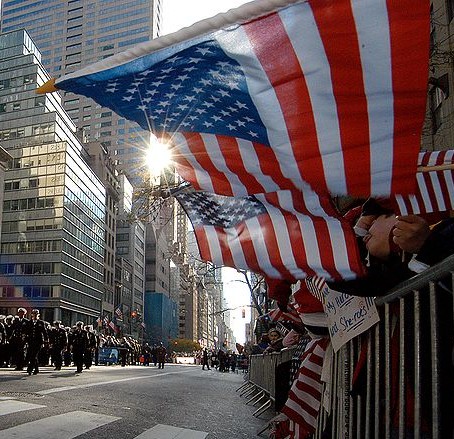
June 14 is Flag Day. This strange little non-holiday marks the day in 1777 when the stars-and-stripes version of the flag was declared our country’s official symbol. Prior to that, the Revolutionary army used a number of different flags, such as the “Don’t Tread on Me” snake banner, the “Liberty or Death” flag, and different star/field configurations.
Flag Day is observed in some U.S. cities, from Quincy, Massachusetts to New York City. It is a state holiday in Pennsylvania. At the beginning of June, most states have a mandated lesson sequence on patriotic symbols that requires students to color flag pages, listen to flag-related stories, and memorize poems, such as this one written for the first Flag Day. It begins: “Your Flag and my Flag!/And, oh, how much it holds/Your land and my land/Secure within its folds!”
The intent of Flag Day is to “carry out a program of a patriotic order, praying for the success of the Federal arms, and the preservation of the Union.”
Our nationalist sentiment on Flag Day apparently used to run on higher octane than it does in most places today. On one of the most famous Flag Days, in 1908, Theodore Roosevelt used a stick to beat a man he saw in the street in Philadelphia because he thought the pedestrian had blown his nose on an American flag. In the midst of the fight, Roosevelt realized his victim’s hankerchief was a blue bandanna with white stars on it. Roosevelt immediately apologized, but then hit the man again for causing the President to become so “riled up with national pride.”

There are people on this day who feel something other than “national pride,” however, and don’t want to pray for the success of Federal arms or the patriotic order. June 14 is also known as Flag Burning Day. Across the country, U.S. citizens are choosing to burn the American flag in protest on this day—their right under the First Amendment of the Constitution.
Or at least, for now. At a number of points in our recent history, usually right before an election, there is a grandstanding move to pass an amendment to the Constintution prohibiting the burning of the U.S. flag. One of the closest near-misses was in 2003-2004. At that time, the Washington Post published a commentary about the emergence of flag burning on Flag Day.
The commentary was anti-burning, calling it “a particularly unpleasant form of expression.” But it advised not to tamper with First Amendment rights, and it also noted that hyper-conservative Supreme Court Justice Antonin Scalia had actually voted down a statutory ban on flag burning. Scalia found himself unable to defy the cornerstone principle of the First Amendment, by which he found himself “handcuffed.”
Reasons for burning an American flag? For the same reason that hundreds of thousands of people around the world burn it: to protest the imperialist policies behind the symbol. As historian Howard Zinn said, “There is no flag large enough to cover the shame of killing innocent people.”
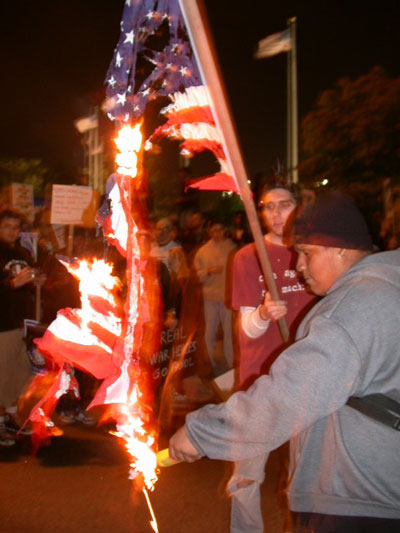
During the 2003 amendment attempt, when the House passed the change to the Constitution (it was later struck down in the Senate), Friction Magazine presented an article by Rev. Nathan Callahan which outlined specifics about the emergence of Flag Burning Day and the reasons for it. Callahan wrote:
Flag Burning Day. It began as a day of national decontamination…A day to end warped notions of patriotism, gaudy jingoist sound-bites, and simple-minded shoulder graphics. A day to end puritanical smugness and preemptive war.
We — the people — refused to allow our rights to be taken away by color-coded fears. We refused to condemn others simply for their beliefs. We defended freedom, not its emblem on a stick…
Let us again strike a match and burn a flag in tribute to those who lit the fire of freedom. We are not only survivors of a dark era in our nation’s history, but inheritors of new emancipation — an emancipation of mind and spirit….When spirit becomes symbol, heart becomes dogma. Today, we are free. Long may it burn. Long may it wave.
So today, some people will be putting on parades and waving American flags to honor this national symbol. Other people will be getting out the lighter fluid, striking matches, and burning a flag to protest this nation’s policies. Both observences are uniquely—and equally—American.
 Grand Rapids Institute for Information Democracy