Local Fair Food Campaigns Kicks Off in Grand Rapids
On Saturday, local activists greeted people at the Fulton St. Farmers Market with information about a new campaign focused on improving the work and living conditions of migrant workers.
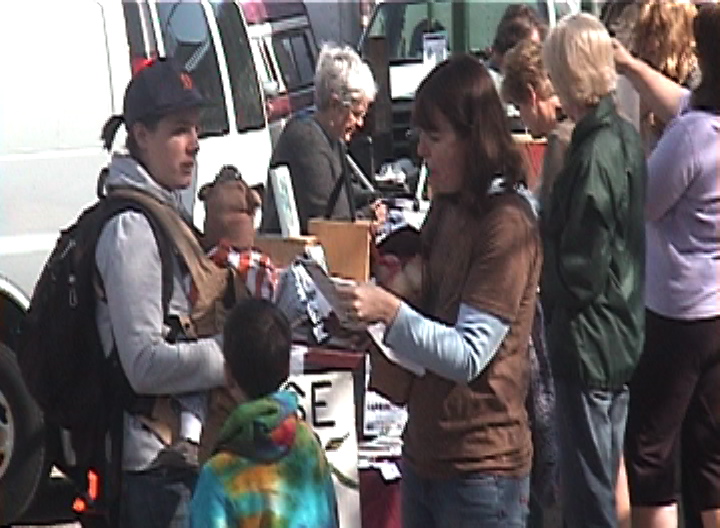
The campaign is called Fair Food and it is intended to educate people about where their food comes from, what the working conditions are for migrant workers and how people can work to promote justice for migrant workers.
The people involved had read the Michigan Civil Rights Commission report on migrant worker conditions last year and were so appalled at what they discovered that they began meeting and developing the Fair Food Campaign. The campaign is based on farmworker justice standards that the group developed by looking at other national campaigns. The nine standards are as follows:
1) Farmworkers should get paid a livable wage for their work and receive at least the federal minimum wage. Currently farmworkers are excluded from the federal minimum wage laws, which includes overtime pay requirements.
2) Farmworkers should not be subjected to forced labor or debt bondage.
3) Farmworkers should have access to educational information about their rights as workers under the law in both English and Spanish. When necessary, translation should also be provided for those whose first language is indigenous.
4) Farmworkers should have access to clean water for drinking, bathroom facilities, and regularly scheduled breaks that follow federal standards.

5) Farmworkers should not be exposed to pesticide application while working in the fields, should be provided proper protection gear when coming in contact with pesticides and should be provided full disclosure (in English and Spanish) when they are working with produce that has been sprayed with pesticides.
6) Farmworkers should be provided just and adequate housing conditions when that is part of the worker contract. Farmworker housing should always be voluntary for workers and not required by employers.
7) Farmworkers should not be intimidated or harassed when attempting to organize fellow farmworkers. The right to form a union should apply to farmworkers. All agricultural employers must provide a mechanism for workers to file any grievances related to the work or working conditions.
8) Federal Child Labor Law should be observed unless the children working on the farm are family members of the farm owner.
9) Farmworkers should not be harassed, intimidated or discriminated against based on their gender, ethnicity or immigration status.
During their time at the Fulton St. Farmers Market they handed out brochures about the campaign and encouraged people to sign a pledge of support. Many people were receptive of the campaign and not only signed the pledge but talked with organizers about other ways they could get involved in the campaign.
Campaign organizers are seeking organization endorsements along with individual pledges, but more importantly they want local grocery stores, restaurants and vendors to ask questions about whether or not migrant workers were involved in the food they purchased and what the working conditions of those migrant workers are. The campaign ultimately wants to nine farmworker justice standards to be adopted, but recognizes that will take some time.
Those involved also said that there is a great deal of interest for people to buy food that was grown locally and that this is a good thing. The Fair Food Campaign just wants people to take it a step further and get people to not only think about where the food was grown, but under what conditions.
The Fair Food Campaign is looking for people to get involved. They plan to go to the farmers market on a regular basis, contact local grocery stores and restaurants to get them to sign on and to try to get other organizations to support the campaign. People can sign a pledge online, join their Facebook group and contact them at fairfood@live.com.
 Grand Rapids Institute for Information Democracy