New Report reveals Obama administration gave stimulus funds to companies with a history of polluting
The Center for Public Integrity has released a new report that looks at how the 2009 stimulus funds were distributed and how in many cases the money went to companies with a history of polluting the environment.
“In the name of job creation and clean energy, the Obama administration has doled out billions of dollars in stimulus money to some of the nation’s biggest polluters and granted them sweeping exemptions from the most basic form of environmental oversight, a Center for Public Integrity investigation has found.
The administration has awarded more than 179,000 “categorical exclusions” to stimulus projects funded by federal agencies, freeing those projects from review under the National Environmental Policy Act, or NEPA. Coal-burning utilities like Westar Energy and Duke Energy, chemical manufacturer DuPont, and ethanol maker Didion Milling are among the firms with histories of serious environmental violations that have won blanket NEPA exemptions.
Even a project at BP’s maligned refinery in Texas City, Tex. — owner of the oil industry’s worst safety record and site of a deadly 2005 explosion, as well as a benzene leak earlier this year — secured a waiver for the preliminary phase of a carbon capture and sequestration experiment involving two companies with past compliance problems. The primary firm has since dropped out of the project before it could advance to the second phase.
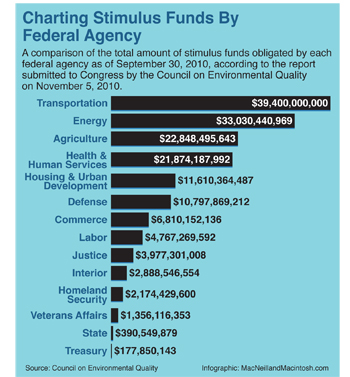
Agency officials who granted the exemptions told the Center that they do not have time in most cases to review the environmental compliance records of stimulus recipients, and do not believe past violations should affect polluters’ chances of winning stimulus money or the NEPA exclusions.
The so-called “stimulus” funding came from the $787-billion legislation officially known as the American Recovery and Reinvestment Act, passed in February 2009.
Documents obtained by the Center show the administration has devised a speedy review process that relies on voluntary disclosures by companies to determine whether stimulus projects pose environmental harm. Corporate polluters often omitted mention of health, safety, and environmental violations from their applications. In fact, administration officials told the Center they chose to ignore companies’ environmental compliance records in making grant decisions and issuing NEPA exemptions, saying they considered such information irrelevant.”
You can read the entire report online at http://www.publicintegrity.org/articles/entry/2565/
 Grand Rapids Institute for Information Democracy