Editorializing on the War on Drugs
The “war on drugs” is probably one of the most understood US policies ever since the Nixon administration gave it that name. Statistically, despite the billions of dollars for interdiction programs overseas and at the US border, illegal drug trafficking has increased in recent decades.
Today’s Grand Rapids Press editorial addresses one aspect of this issue, specifically the status of the investigation into the local missionaries whose plane was shot down in 2001.
The Press editorial is right to express concerns that justice has not been done in this case, since the 16 CIA officers who were reprimanded did not really face any serious consequences for the death of Veronica Bowers and her daughter.
The editorial mentions the 2008 inspector general report, which lays out the details of the incident that led to CIA contractors shooting down the missionary family’s plane. Included in that report was an acknowledgement that the CIA initially lied about the circumstances as a means of attempting to cover up the story.

The editorial also mentions that the Brower family received $8 million in a legal settlement with the government, but that “That may be politically expedience. It’s hardly justice.” The Press editorial ends by stating that halting drug trafficking is a laudable goal, but that there needs to be more checks and balances.
While we would agree that there needs to be more accountability when US government agents act maliciously, but the failure of the editorial misses a major point here, which is that the US Drug War is at best a farce.
Numerous political analysts and former US DEA agents who have been on the front lines of the US war on drugs have testified and documented the massive failure of this policy. Michael Levine, who worked with the DEA for 20 plus years in Latin America wrote the book Deep Cover: The Inside Story of How DEA Infighting, Incompetence and Subterfuge Lost Us the Biggest Battle of the Drug War. Another noted former DEA agent is Celerino Castillo who wrote the book Powderburns: Cocaine, Contras & the Drug War. What both Levine and Castillo argue is that not only is the US war on drugs a failure, but that it was never intended to actually go after the primary drug traffickers in Latin America, because they were often CIA assets.
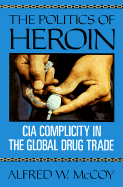
The idea that the CIA collaborates with major drug traffickers is the topic of one of the best investigations into the US war on drugs, The Politics of Heroin: CIA Complicity in the Global Drug Trade. This book by Alfred McCoy documents over four decades of US involvement in the global drug trade. The author argues that the US was often directly involved in the drug trade as a means to generate funds for covert wars, whether those wars were in Afghanistan, Southeast Asia or Latin America.
This notion that the CIA has been directly involved in the global drug trade would help in our understanding of the death of local missionary Veronica Bower and her daughter.
The US has been telling the American public that they are committed to winning the war on drugs in Latin America, yet there has been no evidence that the amount of cocaine has diminished in recent decades.
You will remember in 2000 when then President Clinton allocated $1.3 billion to fight the drug war in Latin American with a policy knows as Plan Colombia. Plan Colombia has not only failed to reduce drug production in Colombia, it has led to the deaths of thousands of innocent civilians. The Washington Office on Latin America published a report this past summer, which documents what a monumental failure Plan Colombia has been, particularly since it has resulted in countless deaths and has further militarized the region.
So while it is appropriate for the Press to editorialize on the lack of justice in the case of local victims of the war on drugs they should be equally outraged about US drug war policies that are in no way laudable. Indeed, the Press might want to have their reporters investigate the local connections and consequences to the so-called War on Drugs.
 Grand Rapids Institute for Information Democracy