We could learn a few things from the French Resistance
(This article by Mike Whitney is re-posted from CounterPunch)

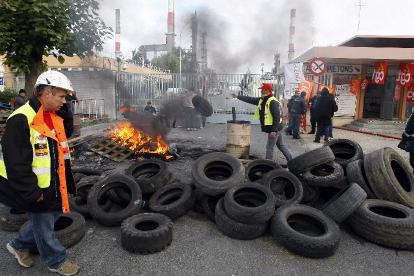
Thank God for France. While American liberals tremble at the idea of sending an angry e mail to congress for fear that their name will appear on the State Department’s list of terrorists, French workers are on the front lines choking on tear gas and fending off billyclubs in hand-to-hand combat with Sarkozy’s Gendarmerie. That’s because the French haven’t forgotten their class roots. When the government gets too big for its britches, people pour out onto to the streets and Paris becomes a warzone replete with overturned Mercedes Benzs, smashed storefront windows, and stacks of smoldering tires issuing pillars of black smoke. This is what democracy looks like when it hasn’t been emasculated by decades of propaganda and consumerism. Here’s a blurp from the trenches:
Headline:
“French Energy Sector Crippled by Nationwide Strike… French energy facilities are close to total disruption in the wake of nationwide strike against the raise of the retirement age…..France has been hit by numerous protests across the country against a controversial pension reform that would rise the retirement age to 62 from 60….On October 22 morning 80 protesters blockaded Grandpuits oil refinery outside Paris, key supplier for Charles de Gaulle and Orly international airport.” (The Financial)
Shut ’em down. Take note, Tea Party crybabies who moan about restoring “our freedoms” while stuffing the backyard bunker with seed corn and ammo. Glenn Beck won’t save you from the “mean old” gov’mint. Liberty isn’t free anymore. If you want it, get out of the barko-lounger and organize. The amount of freedom that any nation enjoys is directly proportionate to the amount of blood its people spilled fighting the state. No more, no less. The man who is willing to accept the blunt force of a cop’s truncheon on his back is infinitely more praiseworthy than the leftist/rightist scribe crooning from the bleachers. The state isn’t moved by lyrical editorials or prosaic manifestos. It responds to force alone, which is why it takes people who are willing to “throw themselves on the gears” of the apparatus and stop it from moving forward. Unfortunately, most of those people appear to live in France.
The resistance is steadily building in France. The budding rebellion is cropping up everywhere—“secondary schools, train stations, refineries and highways have been blockaded, there have been occupations of public buildings, workplaces, commercial centers, directed cuts of electricity, and ransacking of electoral institutions and town halls…” And the big unions are calling for more strikes, more agitation, more ferment.
For more than a week, transportation has been blocked across the France due to the protests by students and workers. Sarkozy’s popularity has plummeted. 65% of people surveyed don’t like the way the French president is handling the strikes. 79% of the people would like to see Sarkozy negotiate with the Union on terms and conditions, but he won’t budge. Thus, the cauldron continues to boil while the prospect of violence rises.
“STRIKE, BLOCKADE, SABOTAGE”
This is from an anonymous striker:
“In each city, these actions are intensifying the power struggle and demonstrate that many are no longer satisfied with the order imposed by the union leadership. In the Paris region, amongst the blockades of train stations and secondary schools, the strikes in the primary schools, the workers pickets in front of the factories, people create inter-professional meetings and collectives of struggle are founded to destroy categorical isolation and separation. Their starting point: self-organization to meet the need to take ownership over our struggles without the mediation of those who claim to speak for workers.
We decided Saturday to occupy the Opera Bastille. This was to disturb a presentation that was live on radio, to play the trouble makers in a place where the cultural merchandise circulates and to organize an assembly there. So we met with more than a thousand people at the “place de la nation”, with banners stating “the bosses understand only one language: Strike, blockade, sabotage.” (end of communique)
The action was met with predictable police violence and mass arrests.
The pension turmoil is not limited to France either. US pension funds are underfunded by nearly $3 trillion. Will US workers be as willing as their French counterparts to face the beatings (to defend “what’s theirs”) or will they throw up their hands and appeal to Obama for help?
There’s no question that Washington elites have joined with Wall Street to offload the massive debts from the financial meltdown onto workers and retirees. Nor is their any doubt that they will invoke (what Slavoj Zizek calls) a “permanent state of economic emergency” to justify their actions. That will allow them to move ahead with so-called “austerity measures” that are designed to impoverish workers and strip popular government programs of their funding. The trend towards “belt-tightening” merely masks the ongoing class war which is aimed at restoring a feudal system of royalty and serfs.
This is from an article by economist Mark Weisbrot:
“If the French want to keep the retirement age as is, there are plenty of ways to finance future pension costs without necessarily raising the retirement age. One of them, which has support among the French left – and which Sarkozy claims to support at the international level — would be a tax on financial transactions. Such a “speculation tax” could raise billions of dollars of revenue – as it currently does in the U.K. – while simultaneously discouraging speculative trading in financial assets and derivatives. The French unions and protesters are demanding that the government consider some of these more progressive alternatives.”
But the retirement age is not really the issue at all. This is about union busting and “putting people in their place.” It’s about “who will call-the-shots” and in whose interests will society be run.
The French are fighting back against this “oligarchy of racketeers” and the ripoff system they represent, while, namby-pamby Americans are neutralized by signing their umpteenth petition or venting their spleen at a Palin rally.
Vive la France. Vive la Résistance.
 Grand Rapids Institute for Information Democracy
This is so well written. And it makes a perfect point (although I don’t agree that all the resistors are in France–Greece, Spain and Italy have all had large recent strikes, although the one in France is currently getting the most attention. A general strike has been called for in Portugal. The Germans had one strike this summer and have just announced that workers will be involved in unannounced work stoppages.)
General strikes work! Compare a European’s job security, health care, and retirement pensions to those in the US. Consider how many would-be dictators like Sarkozy have been removed from office when they work against the people.
I do not understand why every person in this country is not marching, outraged, on the Capital with bricks and flaming torches RIGHT NOW. American workers have been robbed of everything over the last decade–health care that’s affordable, wages that rise with inflation, some semblance of job security–and we just keep our heads down like a flock of sheep. Do you think the difference is at least partly because our press is no longer free, as it is in Europe, or that everyone has been made too scared of losing their jobs to speak out?
I’ll tell you why Americans do not resist. Ask any five people here if their government cares what they think or is responsive to their needs. All five will say no, and many realize who is really in charge, namely Wall Street. Then ask them why they aren’t in the streets fighting like the French. I’d be willing to bet that most of them respond with some variation on “no one cares” or “it won’t do any good anyway.” Decades of propaganda encouraging materialism, self-obsession and fear of “others” has produced the desired effect; namely that the elites are firmly in control and the general population, while to various degrees aware of the real situation, either opt for some escape from the terrible truth or simply follow along and take issue with conveniently provided scapegoats. Thus nothing changes, and popular movements are difficult to mobilize. We’ve a long season of building class consciousness, agitation,organizing, and education if we are to see real radical change in not only the USA but the entire world. Cheers to the French, for not forgetting who they were when the Bastille was stormed.
Goblin, that’s a great explanation and it certainly meshes with my own perception of mostly cowed working class. But you’ve stated the situation very elegantly.
I also think there’s a kind of mental exhaustion at this point. There are so many people right now who have to work more than one job, or who have lost their only job; who are at the point of losing their homes, or are unable to make it to the end of the week with food in the house…
Facing these kinds of issues, it’s hard to move your mind to anything but day-t0-day solutions. As Hélder Pessoa Câmara said, “When you don’t have enough for your children to eat, you only have one problem.”
The bad thing about legislated job security is that if no one can be fired for any reason, there is no reason to work hard. It also acts as a strong disincentive for an employer to hire someone, since they can’t get lay them off or fire them easily. So, it also reduces opportunities for the working class to change jobs – if you work for a jerk, you are unlikely to be able to find another job.
I love France and try to go every year, but if the French don’t have someone on strike at some point in a one to two week visit, it’s strange. Note that this fall’s strike ended at the start of a week-long school holiday, because the students wouldn’t miss their vacations for a strike, but didn’t mind missing classes. The striking didn’t accomplish anything except to hurt the economy.
Dave, I think you miss the point, the strike was meant to hurt “the economy” meaning the power structure that primarily benefits from unjust economic and labor practices. I also don’t think there is much evidence to support your claim that workers with job security are “lazy.” The research of sociologist like Juliet Schor show that when workers are treated well, both in terms of pay and work conditions that workers are more productive. In fact, this is best seen with the worker run businesses in Argentina that came about because of the economic crash in 2001. See the book Sin Patron and the film The Take.
In a worker-run business, workers get a share of the profits, so they have an incentive to work harder. So, of course they work hard. If there is neither a bonus for working harder, nor a risk of penalty for not working hard, most people won’t work particularly hard. I present the government as an example. At the state level, think of the DMV. I’ve done federal government contracting for about 15 years and I’ve seen plenty of federal employees who flaunt the fact that they cannot be fired.
The sad thing is that the strike mostly hurt small businesses, whose owners also are workers. It’s like poking a hole in a lifeboat in order to hurt the rich people in the boat. When it sinks, everyone drowns.
In desperate economic times, it’s not the power structure that goes without eating, it’s the workers.
history has shown that when workers strike that solidarity is built and working people look out for each other…..see Jeremy Breecher’s book Strike. The worker collectives in Argentina are quite successful, because the business is democratically run……that is what provides incentives not profits. People take care of each other. I have lived in a co-op for 26 years and can attest to the solidarity that is built. But it seems pretty obvious that we come from two completely different places on these matters.
I agree that in small, properly motivated instances, these things can succeed as in your experience, but, unfortunately, motivating 65 million Frenchmen, or 300 million Americans, is an awful lot harder. Most people simply never get that solidarity and the working class cannot achieve class consciousness. People end up looking out for themselves because they lose track of the collective goals.
Sorry to have intruded.
no intrusion……..the example of Argentina involved thousands of workers and in Brazil with the MST you have 1 million people engaged in a collective effort to reclaim land and run it cooperatively. Historically, there are lots of examples in the US where there was a great deal of class consciousness and solidarity as is well documented in John Curl’s “For All the People.” This history tends to get suppressed, which makes it harder for contemporary Americans to build solidarity, but it is happening nonetheless.