Election Ads Breed Apathy and Ignorance
(This article was submitted by Aquinas College student Joe Spaulding)
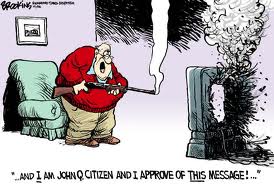 Post-structuralist philosopher Michael Foucault talked about how what he called the “repressive hypothesis” – the idea that the nature of power is purely repressive, and individuals can empower themselves by fighting whomever is in charge.
His book The History of Sexuality Vol. 1 was specific to government and individual power over sex, but he uses that specific example to show that the repressive hypothesis is pretty terrible at accurately describing the nature of power relations. He also argues that the public’s acceptance of the repressive hypothesis as a true concept, can be used to further control them. Because people think they have the ability to resist, they are actually easier to control.
During the over-bloated onslaught of inescapable campaign ads, the American public is set to fall victim to the perilous political trappings of the repressive hypothesis once again. There are a few reasons for this, as well as a few implications, but the good news is, as long as people are mindful and observant, they should be able to help keep real democracy alive in America.
Most people know campaign ads should not be taken at face value, and politicians should not be taken at their word, especially when they are running for office. If a person is particularly partisan, they might see through what they perceive as the lies in the ads of the opposition, while meeting the candidate they favor half-way with claims that might be stretching the truth.

As shown by the growing dissatisfaction with the two major political parties as well as the two party system itself, most people aren’t decisively partisan. Not being blinded by ideology, most people can tell that the ads for candidates from both parties for every office worth running ads for are filled with both boastful and insulting lies.
The truth is so blatantly distorted in political ads that it’s difficult not to immediately recognize the dishonesty and hypocrisy. People can watch an ad accusing candidates of caring more about workers in China than in the U.S., and they know that is not be true for virtually every person running for every office here. When someone like Republican candidate for governor Rick Snyder claims he “created thousands of jobs” in his ads, most people know he wasn’t personally and solely responsible for those thousands. If the politicians in the ads didn’t get to hold an office of power after the election, these ads would simply be a rhetorical spitting contest not far from the dozens.
Why do lies matter if everyone can see through them? Because recognizing a lie makes a person feel satisfied and intelligent, and individuals that are those things are less likely to suspect they are able to be deceived This, rationally enough, makes them much easier to deceive The nature of this particular deception is one of masking. The thinly veiled lies in political ads create the illusion that the differences between Democratic and Republican candidates are vast enough to distort the truth over. They provide the framework necessary to convince masses of voters that the only standard that matters in the ballot box is selecting the lesser of two evils.

Make no mistake, if Pat Miles and Justin Amash, or Rick Snyder and Virg Bernero were so different, they wouldn’t need to spend millions of dollars trying to convince you those differences are real between 30 Rock and The Office or during the 7th inning stretch of the National League Championship Series final game.
The other aspect of campaign ads that has deeper impacts than the ones that are initially obvious is their pervasiveness. Billboards can be seen on the way to work, radio ads can be heard on the same trip or on the job site itself, online ads are visible at home and work as well, and television ads are as common as televisions themselves. This provides a huge psychological disincentive to researching candidates on an individual’s own time. Why would people want to spend the precious few moments they have out of earshot and line-of-sight of political ads looking up politicians’ positions? When individuals have this sentiment, and it is combined with the idea that they have seen through the obvious lies in ads, they end up dually deceived. They think they understand the candidates well and are extremely disinclined to check if their understanding is less than accurate. Political ads simultaneously breed ignorance and the acceptance of ignorance.
The pervasiveness and thinly masked deception that come with the political ad season will once again have the effect of pacifying the American public into accepting the two party system, and keeping them further alienated from their government. The traditional media will continue to do little more than report on which candidate’s tidal wave of airtime is having the best effect in the polls. At the very least, unstoppable ads will convince many that they only have two options at the ballot box; this undemocratically disempowers Libertarian, Socialist, Green, and other parties’ candidates and their supporters.
There are structural barriers to overcoming this desecration of democracy, like our winner-take-all/non-proportional representation elections, but they have no chance of being overcome until individual citizens take it upon themselves to put up with the garbage of political ads, and do the research themselves.
The real-time access to information the internet provides gives people today the tools to better understand who is being elected to govern them. People need to not be content that they saw through an obvious lie on a prime-time 30 second spot. They need to dig deeper to see what candidates’ positions really are, but they also need to vote their conscience. The old “I don’t know anything about this third party candidate’s policies because the have no ads” excuse doesn’t fly in the online age.
Traditional partisan politics has resulted in watering down bills that the public needed to be robust, fights over cutting taxes for those that need it least, and inaction at times when action was necessary. Obviously, and importantly, people, once they have informed themselves, need to vote. Things probably won’t change a great deal with a single election, but change will become evident in every new election over time. As long as people continue to put in the effort despite disincentives, we can make both Michigan and America more democratic.
 Grand Rapids Institute for Information Democracy
Joe, thanks for sharing this well-thought-out piece. While I’m not sure I agree that democracy is still alive in the US, your analysis of how media and adverstising work on us and why it is damaging is incisive.
Thank you Kate. I hope you don’t hold my beliefs about democracy in the U.S. against me too much. I’m well aware of our rapidly eroding freedoms. It’s just, when I see the dominant power structure clamping down on the people it controls, I think the opportunities to effectively resist those modes of control become more visible and viable (even if the consequences for rebelling, even discursively, are more severe). I think the ability for resistance to aggregate is the essence of democracy. But ultimately, I think the degree of democracy in the U.S. is a totally dependent variable, we need to be focusing on the factors that impact it. Whether there is a little bit of democracy left here, none, or a ton, I think we should be trying to work towards it as a goal. It would be nice if the media would help us out.
Joe, I definitely agree with you that a government run by the people for the benefit of the people would be a great thing, and worthy as a goal. But I just don’t think what we have now. And I do believe that deregulation and consolidation of the media plays a huge part in that.
We no longer have a truly free mainstream press. This is largely due to deregulation that started in 1996 and was cemented into place in 2002 that lifted most of the restrictions against one company owning more than one media outlet in a single area. The new law was challenged, but in 2007 it resurfaced. The FCC keeps working on behalf of the capitalists toward making it possible for one large company to own multiple newspapers, TV and radio stations in a single area.
A classic example of how this works against people receiving information they need was during a train derailment in North Dakota in 2002. Toxic substances were released into the air, and 1,600 people were poisoned. But every news outlet in Minot was owned by Clear Channel Communications, which squelched the story. Many people who were poisoned could have been saved by better communications.
Media consolidation isn’t the only element in the destruction of democracy in the United States, but we have been hobbled even more by these deregulatory actions. In Europe, although there are large media monopolies–such as Rupert Murdoch’s–there is also a more established tradition of independent press and broadcast. We are just beginning to lay the foundations of alternate media here.
You are absolutely right in pointing out that people can use the Internet and other alternative media to educate themselves. It’s my hope that independent media will become more and more accessible and trusted in this country and will become a means of giving us back the ability to get the truth to people about elections, local and world news.
I would urge people to vote for Miles. Amash got a 0% rating from the environmental organization League of Conservation voters. HE VOTED AGAINST EVERY PIECE OF ENVIRONMENTAL LEGISLATION !!!!!
The polls have tightened in this race and with get out the vote efforts Miles has a good chance of winning.
Amash also voted to deny special efforts to contact elderly people when their heat was going to be cut off.
Vote for Pat Miles!!!
A third party vote on this one is wrong.