Michigan shortfalls in education a concern for business leaders
(This is one of several articles that GRIID will post over the next few days based upon our attendance at the West Michigan Regional Policy Forum.)
Dr. Shirley Robinson Pippins works as the senior vice president of programs and services for ACE, the American Council on Education. ACE lobbies for the interests of campus executives and leaders of higher education “in matters of public policy in Washington, DC, (the location of its offices) and throughout the nation.”
Pippins was a good choice for the assigned topic, “Making Michigan Globally Competitive, Cradle through Multiple Careers.” She began her career working in Headstart programs, including one here in Grand Rapids. However, this writer finds the business sector’s interest in molding infants and preschoolers, let alone elementary and high school students, into a “competitive” labor force troubling at the very least.
Despite that concern, Pippins’ rapid fire talk brought out some key problems with our educational system that the business sector may not have wanted to hear. “For global competitveness, you need a diversified, skilled workforce. The key is that the foundation of education and skills is not just for a 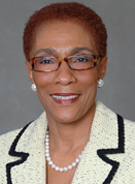 privileged few but for everyone,” she opened. “The US no longer leads the world in post secondary attainment.”
Pippins noted that among the challenges facing Michigan’s job market, 62% of new jobs will require post secondary education and only 33% of its adults have attained that. Michigan has a shrinking pool of high school graduates; 13% of our adults have neither a high school diploma or a GED–and Michigan’s current GED policies throw up barriers making it difficult for many to complete GED programs. “The best and brightest are leaving Michigan at alarming rates. If a student leaves the state for education, they probably won’t return to that state.”
Pippins went on to say that Michigan is home to many educational disparities. Poor children and black children are left behind because of insufficient funding for education at all levels. When students get to college, they lack academic preparedness. And, there is insufficient financial aid for the poor. Because the state is cutting aid to colleges and universities, tuition costs rise making higher education less attainable. “There is a lack of academic preparedness and insufficient financial support for the poor,” Pippins said. “You have substantial gaps between whites and blacks and both groups fall behind their counterparts in other states.”
Pippins didn’t mention Michigan legislation that prevents prohibits affirmative action programs. It seems this, too, is most likely widening the gap between the number of blacks and whites attending colleges and universities.
She did say t hat Michigan’s best and brightest kids are taking less math, that reading and writing skills are lacking and, their scores on advanced placement tests all raise concern. Another problem, Michigan has a low “persistence to degree completion” rate. In other words, many who begin college don’t finish. “Michigan needs to improve its post secondary education attainment levels, stop loosing students and increase academic success” if the goal is a competitive global work force.
Pippin said the state needs to “begin at the beginning” with effective early intervention, She mentioned the Michigan Early Childhood Investment Corporation and private sector/public education initiatives in other states, Again, this writer finds the intrusion of private sector business into public education troubling. She also mentioned that the state needs to develop lifelong education models that better prepare high school students for college; increase the number of students graduating from community colleges (where the state has high non-completion rates); and implement effective adult education models, including GED programs that are more accessible and better focused on readying people for college or career.
“If we’re not supporting higher education, it’s hard to have incredible expectations,” Pippin said. “That starts with K to 12 . . . so we get our best and brightest involved in the system.”
 Grand Rapids Institute for Information Democracy