Before and After Bagua
(This article is by Paris Conwell – GVSU student)

This past January, I spent a month in the San Martin region of the Peruvian High Amazon as part of a study abroad program through Living Routes. The title of the course was “Community, Ecology, and Indigenous Spirituality in the High Amazon”. While intended to be an anthropology course, what us students found ourselves faced with demanded much more than the passive observation I had usually associated with the field of anthropology.
Within the San Martin department of Peru is the province of Lamas, which is home to the Kichwa-Lamistas, an indigenous society of about 22,500 people. During the program we had the opportunity to meet, interact, and live with some of the members of the Kichwa-Lamistas while we resided in Lamas, and it was during this time that we learned about the Bagua massacres.
On June 5th, 2009, approximately 5,800 Peruvians, mostly natives, were gathered just outside of Bagua, a town only 6 hours car ride from Lamas. They were gathered there for a strike that had begun April 9th, 2009. The strike included a roadblock and the taking of two nearby pumping stations and intended to protest the Free Trade Agreements (FTA) signed between the U.S under the Bush Administration and the government of Alan Garcia in Peru on December 4th 2007. These agreements, and the promulgation of hundreds of legislative decrees by Garcia, have opened indigenous territories to multinational companies without the consent of the indigenous people, and at the expense of their physical, mental, and spiritual well-being. The protests provoked a violent repression on behalf of Garcia’s government, now referred to as the “Bagua massacres” on June 5th this past year. The police attacked at 5:30 am releasing tear gas and firing machine guns at the natives who were armed with lances, stones, and bows and arrows to defend themselves. In the official death toll it was released that 24 police officers and 10 civilians were killed. However, according to various native and social movement communities, there are an estimated 200 to 500 persons involved in the strike who were “disappeared” by being thrown into rivers from the police helicopters and their corpses being burnt.
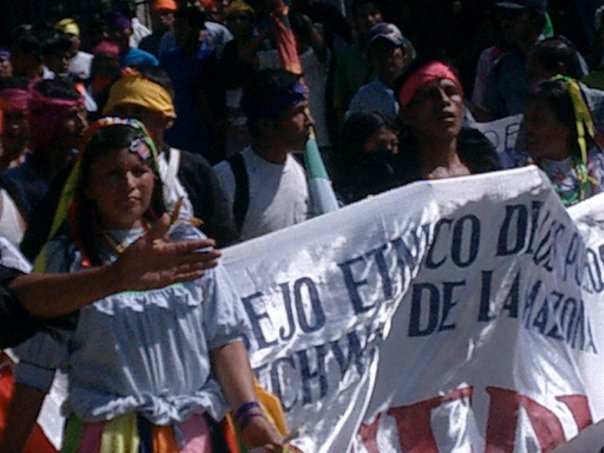
The burning of corpses, in addition to disposing of the bodies by throwing them into the rivers and dumping them from the helicopters, was an effort to greatly decrease the official death toll of native Peruvians and to hide the government’s brutality.
The press was also heavily censored: the government presented a biased account of the events that day and was the sole provider of information for the international media. In a New York Times article written by Simon Romero covering the events that unfolded at the Bagua massacre it reads:
“Initial accounts of the clashes varied. Indigenous leaders here said the killings unfolded early on Friday after the police fired from helicopters on hundreds of protesters who had blocked the highway in the northern Bagua Province, with at least 22 civilians killed. The Chachapoyas Medical Association, in the region where the killings took place, put the number of dead Indians at 25”.
The New York Times article demonstrates the bias and unsound “facts” surrounding the Bagua massacre that is characteristic of the Peruvian government under Garcia as well as the country’s media. It is unfortunate that a major news such as the Times promulgates the racist viewpoints of the Peruvian media and government in their publishing of this article, and that this reflects the tone of the majority if the international coverage of the Bagua massacre. Here is a link to the full article: http://www.nytimes.com/2009/06/06/world/americas/06peru.html?_r=1&scp=1&sq=bagua&st=cse
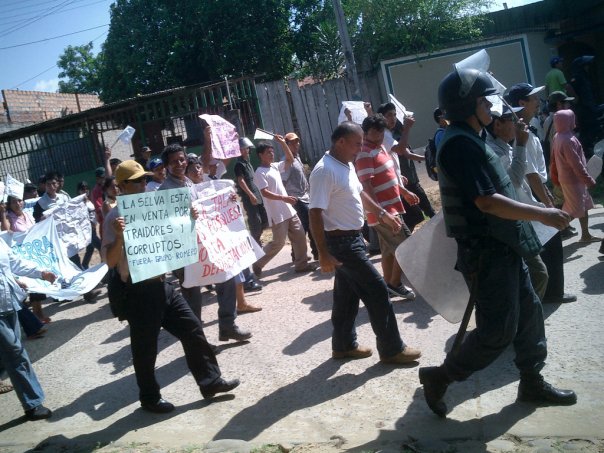
The tone of the reportage on the day of the massacre was biased and racist. Alan Garcia and members of his cabinet as well as the reporters themselves frequently used racist language to describe the native peoples, citing the natives’ efforts to protect their lands as greedy attempts to keep the resources and wealth for themselves because they do not want the land to be privatized or given in concession to transnational companies. Garcia himself called the indigenous people primitive, ignorant savages who stand in the way of progress for all Peruvians.
In the months that preceded Bagua, indigenous leaders sought ways to address the destruction being wrought on behalf of the Free Trade Agreement and Garcia’s marginalizing legislative decrees. In April 2009, leaders of indigenous groups went to Lima to discuss the issue. The leaders returned and discussed the situation with their communities, and it was decided that a strike would be best once it became clear that the Peruvian government was only willing to listen to a few select, elitist and corrupt representatives of indigenous groups who do not properly amplify the voices of the indigenous communities.
The signing of the FTA between the US and Peru has wrought a destructive force comparable to the 16th century conquest of the region, all in the name of “progress” and “development”. It is estimated that 75% of the Peruvian Amazonian territories have either been sold, given in concession, or promised to private enterprise.
Deforestation for a monoculture is a crime. The opening and selling of indigenous territories has led to well documented deforestation, mining, and oil extraction and consequently, environmental disaster and the displacement of people.
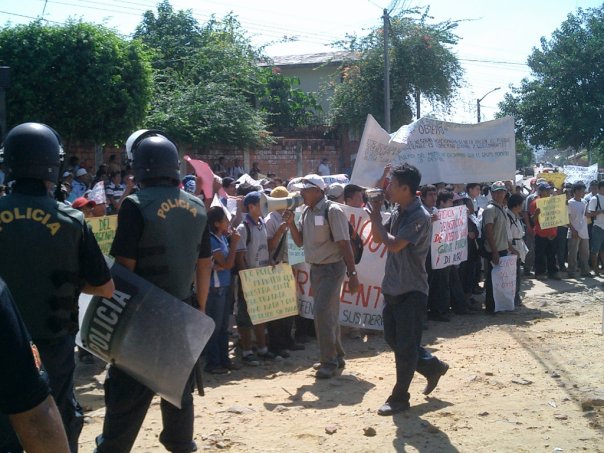
The FTA was ratified in Peru June 2006 and went into affect February 2009. The government of Alan Garcia created a package of 99 reforms to implement the FTA. More than half of these forms have been found to be unconstitutional and directly infringe upon the rights of the indigenous peoples. CEPKA, and indigenous organization representing many of the Kichwa communities, has cited seven specific laws that infringe upon their territorial rights, specifically.
In 1993, Peru ratified the International Labor Organization’s Convention on Indigenous and Tribal Peoples. This convention provides a legal basis for the indigenous people’s struggle against the FTA and the contracting of their land to private companies, particularly part II, Land, articles 13 and 14 in which the government pledges specifically to recognize and respect the lands the indigenous people occupy or otherwise use or traditionally have access to.
In addition to this, on September 13, 2007 the General Assembly of the United Nations adopted the Declaration on Rights of Indigenous Peoples, of which Peru is member. Only 4 nations voted against the declaration— New Zealand, Canada, Australia, and the United States.
As a member of the UN and a signatory of the ILO Convention, Peru is legally obligated to grant certain rights to its native peoples.
Since Bagua, Garcia has apologized and two of the most grievous laws have been amended, however many of the exploitive decrees still remain.
Native communities are devastated by the massacres at Bagua, and now refer to the magnitude of the hardships they face as being “before and after Bagua” as the event marks the pinnacle of violence on behalf of the Peruvian government in regards to the Free Trade Agreements.
The indigenous people of Peru are not against progress. They want to be able to make decisions regarding their territories and to be granted the rights promised to them through the ILO and UN. The forests are their markets, they are a source of subsistence that sustains their livelihood and their cultural identity. Indigenous communities hold a wealth of knowledge about their land. In destroying their lands, the communities are also destroyed and deprived of their wealth. Despite the legal status of these issues, there exists a moral obligation to protect the rights of peoples whose worldview challenges that of the modern west. If we are to ever discuss issues of sustainability, and the physical, mental, and spiritual health of our planet and its inhabitants, we must learn to dialogue with the voices that are often left unheard in their never ceasing challenges to our paradigm of thought.
Towards the end of the study abroad program, all of us students felt the obligation to share what we learned with a western audience. We realized the role our own country plays in the destruction and suffering of the peoples and places we encountered while in the High Amazon, but more importantly, we realized the self-destruction inherent within such practices that ultimately will lead to our planet’s demise, and are responsible for the spiritual deficit we are faced with in the west. Addressing these issues is not a matter of helping “others”; our well-being is bound with those who first feel the damage done. It is just that we are not yet directly and blatantly faced with the affects of our own undoing.
 Grand Rapids Institute for Information Democracy