The Treatment Plan for Haiti: Building Back Stronger and Better
At noon today, Dr. Joia Mukherjee, medical director of Partners in Health (PIH), spoke to staff at Spectrum Health on their work in Haiti. Dr. Joia said that in all of her years of doing this work, nothing has taught her more about social justice than her work in Haiti.
Before she talks about what has happened since the earthquake she felt it was important to talk about Haiti’s history. Dr. Joia felt it was important to provide a context for the current situation in Haiti, unlike how most news agencies have reported since the January 12 earthquake.
Dr. Mukherjee said that 1 in 10 people affected by the catastrophe died immediately after the cataclysm. Then the punch line was, “from the slave trade.” To illustrate the importance of Haitian history, Dr. Joia that “Haiti would not be what it is without the trans-Atlantic slave trade. Haiti is a country really born out of slavery, the first country to end slavery and the only country to be founded out of a slave rebellion.”
The response to the Haitian revolution from the US was an embargo by the Jefferson administration. “Why is this relevant?” asks Dr. Joia. “If we look at what happened in Chile, where the earthquake was bigger, fewer people died. So we have to ask ourselves why more Haitians died?” The doctor stated it is because of the history of exploitation of Haiti by various imperial powers, which has created more systemic poverty and a failing infrastructure.
Haiti has become increasingly an urbanized country, in part because US grains have flooded the country making it difficult for Haitian farmers to make a living off the sale of their crops. More people crowded into urban centers increased the chances of people dying during the earthquake. According to Dr. Joia, the number of dead was 250,000 and an additional 300,000 injured. Again this is due to the failed infrastructure in Haiti, particularly with inadequate housing and government buildings.
PIH relies a great deal on using and training local health care workers. Their approach to health care is a systems approach and everyone of their staff in Haiti are Haitians. When the earthquake hit they PIH staff immediately went to the communities to determine what they would do. But the hard question facing them was “how does a human rights and health organization respond to the needs of disaster relief?”
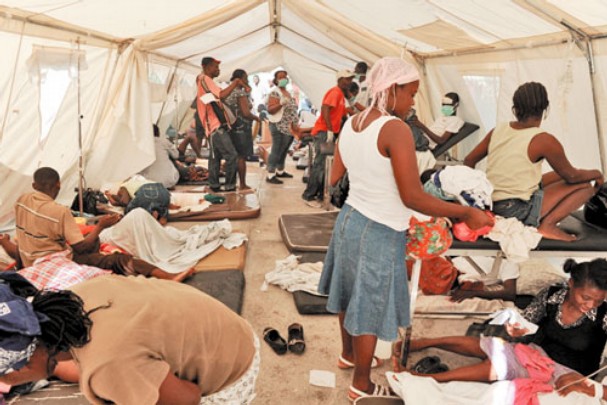
PIH has historically focused a great deal of attention around doing work and seeking funding to support HIV treatment and prevention. When they first started clinics around HIV/AIDS work they were successful because they eliminated any fees at the clinic, but the other thing they did was to pay the staff. For PIH health care is a right. The third thing they did was to provide free medicines and the fourth thing was to send health care workers into the community who couldn’t come to the clinic. “The key here,” according to Dr. Joia, “was that this whole approach was not about a building, rather it was about the people.”
During the relief work they always insisted on a fully integrated medical team with Haitians and outside volunteers, instead of just allowing foreign volunteers to work separately. “We believe that this will have lasting impact because of these kinds of partnerships so that Haitians can build their capacity for responding to these kinds of problems in the future.”
Dr. Joia sees the possibilities of increased funding for Haiti as an opportunity to focus on long-term infrastructure improvement instead of funding as a response to the disaster work where money gets channeled to NGOs who are generally not engaged in the Haitian communities. In contrast, PIH hired hundreds of Haitians to go into the communities to find the sick and wounded, do some assessments and then bring them to the health care facilities they operate. At present they see about 1,000 people per day in the clinics.
A few other areas of interest that PIH focuses on are rehabilitation and mental health care. These are issues that generally get ignored in the top-down approach to medical care, especially since the earthquake.
The last thing they do is to do promotional work to stop a brain drain of Haitian doctors, so PIH promotes the amazing work done by Haitians to show that Haitians are really the ones doing the important work.
The ongoing challenges of the earthquake will be the resettlement of 2 – 3 million refugees, needs for all kinds of shelter/housing and ongoing medical support as the immediacy of the earthquake is less in the news now.
In her critique of many of the mainstream and US-based NGOs Dr. Joia said that many of the groups that have raised a ton of money “because they have sophisticated media machines. They don’t care if people spoke Creole or not.” She even says that there is graffiti in some parts of the country that says “down with NGO thieves.” NGOs have lots of vehicles, lots of bosses and less staff on the group. Dr. Joia said that 46% of the US money went to the US military and the bulk of the rest went to US NGOs, which have a large overhead.
We asked her about Naomi Klein’s critique that the earthquake is another example of the Shock Doctrine, where more of Haiti’s basic services are being privatized. She agreed with Klein’s analysis and said that PIH wants to do the work to empower the local communities and the government in order to prevent or minimize the push to privatize Haitian services.
Dr. Joia’s presentation was passionate and impressive. It’s too bad that the local news media was not present to share this analysis with the broader West Michigan community.
 Grand Rapids Institute for Information Democracy
Trackbacks