Students Host Cesar Chavez Celebration at GVSU

Today, about 100 students and faculty marched on campus to kick off a celebration of the life and work of labor organizer Cesar Chavez. After the march, people gathered in the Cook-Dewitt Center to listen to speakers and enjoy some refreshments provided by the Latino Student Union.
The first presenters were two students with the Latino Student Union, who gave a short presentation about the life and work of Cesar Chavez. They stated that in 1952 Cesar became an organizer with the Community Service Organization (CSO). Later, Chavez began to work with the United Farm Workers of America. (UFW)
The students also addressed some of the conditions that farm workers faced in the 1960s. Workers were subjected to harsh conditions, both living and working conditions. Child labor was widespread at that time, conditions that are still prevalent today in Michigan.
The students went on to say that Chavez began to organize marches and campaigns to challenge farmer owners and the agribusiness industry. The first big campaign was targeted at grape farmers, since farm workers in this sector were treated worse than in other areas. Over the years, the UFW won better worker conditions better wages and even union co-ops and credit unions. But they students impressed upon everyone in attendance that farm workers are still fighting for justice and need our public support.
Chicano Movement
Speaking in place of Dolores Huerta (who was scheduled to speak but had to cancel), was a professor of modern languages and history at GVSU. The focus of her talk was the Chicano movement in the US, which often overlapped with that of the farm worker movement.
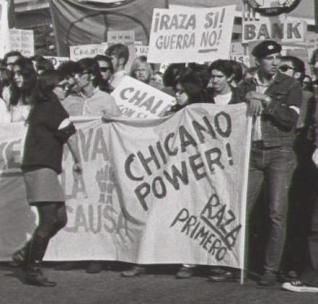
The Professor started off by looking at some of the history between the US and Mexico and the importance of land that was taken in the US-Mexican War. Chicanos are basically Mexicans who were born and raised in the US, she said, who identified with Mexican culture and became part of the movement of La Raza – “The Race” or “The People.”
During the 1960s the Chicano Movement and Chicano Power came into being, demanding civil rights and forming political and community based organizations. Some in the early Chicano movement advocated for reclaiming land that was lost under the Treaty of Guadalupe Hidalgo in 1848.
The Chicano movement also gained strength during a youth conference in 1969, a conference that focused on discrimination, justice and oppression. There were two major outcomes of this conference. First was the creation of the Chicano Student Movement, which organized around an effort to fight for land rights. The other outcome was the development of Chicano studies at the university level.
Many who were involved in the Chicano movement also participated with Cesar Chavez and the UFW in the 1960s in marches and boycotts. She also mentioned that because of the power of the UFW, Robert Kennedy agreed to meet with Chavez during the tail end of one of his fasts. Kennedy endorsed their campaign and in turn the UFW endorsed RFK for President in 1968.
Other aspects of the Chicano Movement there was a lot o cultural revolution. Prof. mentions the origin of the Zoot Suit movement, the influence of music, literature, and independent news. A great deal of this cultural influence was focused on identity and heritage of Mexican American people. One other manifestation of this culture was the Teatro Campesino, the poor workers theater.
The presenter also mentioned that more scholars are beginning to recognize the role of Chicana women in the movement, but the scholarship is still limited in recognizing the contributions that women made to the vitality of the movement.
The Professor also mentions the emergence of Chicana feminists, particularly writers. It is here that the speaker talked a bit about Dolores Huerta. Huerta faced her own challenges as an organizer with the UFW, such as being attacked for not being “a traditional mom” and for questioning male dominance in the movement.
While the focus ended up not being primarily about Cesar Chavez and farm workers, the information shared was important for understanding the movements that Mexican/Americans and Chicanos made to civil rights in the US.
 Grand Rapids Institute for Information Democracy