The Language of War: The Press and the Framing of Soldier Deaths
War always has consequences beyond the loss of life. One of those consequences is how it impacts how we talk about it. This is particularly the case in recent decades, as wars have now become much larger media spectacles.

We have all heard new terms that both the Pentagon and the media use when discussing aspects of war. In the aftermath of the US invasion of Panama, the Pentagon began using the term “collateral damage” to refer to civilians killed in a bombing raid. Other terms that have become part of our vocabulary are smart bombs, water-boarding, peace-keeping forces, and joy-stick soldiers.
All of these terms inform our perception of what is happening in war, even though it may contribute to a distortion of what is actually taking place. During the US war in the Persian Gulf it was widely reported in the US media that smart bombs were being used to minimize the amount of civilians killed or injured. Years later it was reported that these “smart bombs” were in fact not very accurate.
The use of buzzwords and propaganda was taken to a new level with the most recent “War on Terror,” according to the book Collateral Language: A User’s Guide to Americas New War, co-authored by John Collins and Ross Glover. Collins and Glover provide an excellent collection of essays that systematically investigate words being used by the Pentagon and the news media in the US since 9/11 and how that affects the way we talk about war.
The GR Press and Collateral Language
Yesterday, the Grand Rapids Press applied its own form of collateral language in a front-page story about a former Lowell high school student who was killed in Afghanistan.
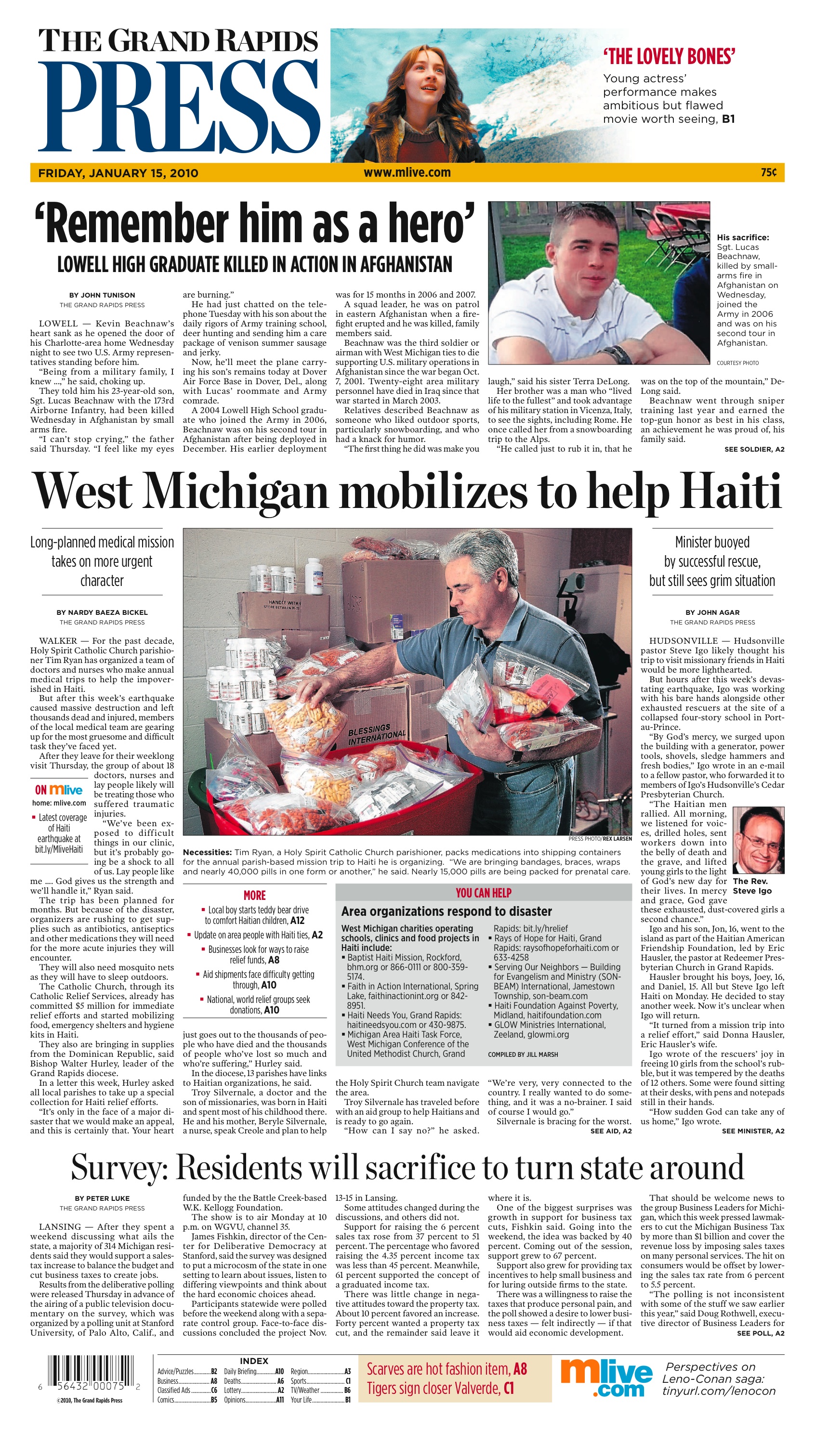
The story itself focuses mostly on what the death of this soldier meant to his family. The reporter talked about what kind of person Lucas Beachnaw was growing up, his relationship to his family and that his last stint in Afghanistan was his second time.
The headline of the story read as, “Remember him as a hero.” This headline was a direct quote from Beachnaw’s sister, which one can understand how a family member might feel that way about a brother killed in war. However, does that mean that the news media uses these terms just because someone close to them dies?
The article said that Beachnaw had some training in “helicopter landing zones” and last year he “went through sniper training.” The story doesn’t provide much information about the circumstances of his death, other than to say “he was on patrol in eastern Afghanistan when a firefight erupted and he was killed.”
We don’t know if Beachnaw saved individual Afghanis or did anything in particular that could be considered heroic. In fact, as someone with sniper training he could have spent his time shooting Afghanis who were suspected of being members of the Taliban or sympathizers of the insurgents. There have been many documented cases of civilian deaths at the hands of US soldiers since the US occupation began in October of 2001, like the most recent report of US troops killing Afghani children.
What we cannot assume and must not assume is that anyone participating in war is a hero. We should expect and demand that our news media not do the same thing. It is one thing for family members to consider loved ones heroes, but an entirely different matter when the news media portrays US soldiers as heroes.
 Grand Rapids Institute for Information Democracy